
You’ve seen the promise of multi-agent AI.
Multiple specialized perspectives. Different expertise angles. The wisdom of crowds, automated.
You’ve also seen what actually happens.
Agent A calls Agent B. Agent B calls Agent C. Each call adds latency. Each handoff adds cost. Nobody governs the transitions. The output is a patchwork of conflicting voices. And when something goes wrong, good luck figuring out where.
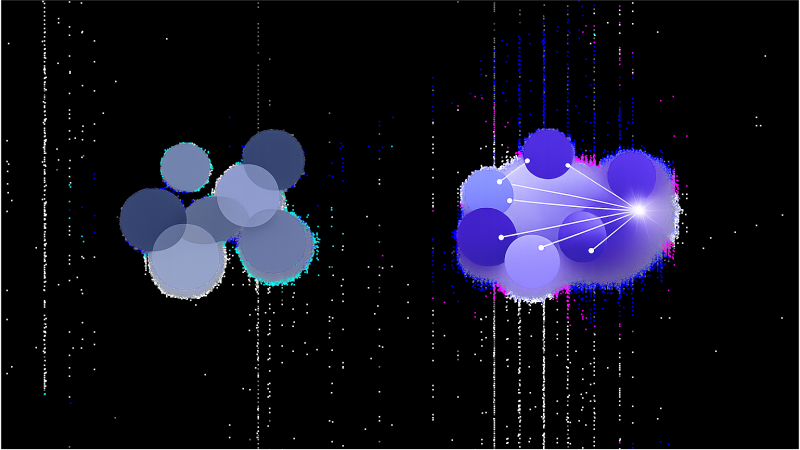
This is what happens when multi-agent systems are built like conference calls instead of editorial rooms.
The Problem With Chained Agents
Most multi-agent systems work by chaining API calls. One agent generates output, passes it to another agent, which generates more output, passes it to another.
The architecture seems logical. Specialize agents, connect them, let each do what it’s good at.
The reality is chaos.
Every handoff between agents is a potential failure point. Every API call adds latency and cost. Every transition creates a governance gap where safety and consistency can slip. The more agents you add, the worse it gets. Costs explode. Latency stacks. Quality degrades.
And the output? It reads like a conference call transcript. Multiple voices, no synthesis. Everyone spoke, but nobody actually listened to each other.
Conference Call vs. Editorial Room
Think about how these two environments produce content.
A conference call brings people together, but there’s no structure. People talk over each other. Points get lost. Someone dominates while others check out. At the end, you have a recording, not a document. If you want something usable, someone has to go back and synthesize it manually.
An editorial room works differently. A writer drafts. An editor critiques. A fact-checker verifies. A safety reviewer ensures nothing problematic slips through. They don’t talk over each other. They negotiate. Disagreements surface, get resolved, and the resolution is documented. At the end, one coherent voice emerges, informed by many perspectives.
Most multi-agent AI operates like conference calls. ORCHESTRA operates like an editorial room.
The result isn’t just better answers. It’s answers you can stand behind.
| Conference Call | Editorial Room |
|---|---|
| Chained API calls | Single-pass execution |
| Costs explode at scale | Fixed cost regardless of agents |
| Governance gaps between agents | Continuous governance |
| Agents talk over each other | Perspectives negotiate and synthesize |
| Black box output | Transparent synthesis |
What Single-Pass Coordination Actually Means
Here’s the architectural innovation that makes ORCHESTRA different: everything happens in one pass.
All agents contribute their perspectives. All disagreements surface. All negotiations resolve. All safety checks run. All synthesis happens. One call. One output.
This isn’t a small optimization. It’s a fundamentally different architecture.
Traditional multi-agent systems chain calls because that’s how they were built. Agent frameworks assume agents are separate services that communicate through APIs. ORCHESTRA treats agents as coordinated perspectives within a single reasoning process.
The result: you get multi-perspective quality without multi-agent chaos. Five agents don’t multiply cost the way chained systems do. The complexity stays internal. The output stays coherent.
A Different Kind of Interaction
Here’s what this looks like in practice.
Conference-call system:
User asks complex question requiring multiple perspectives.
- Agent 1 generates response. (API call, 2 seconds, $0.03)
- Agent 1’s output sent to Agent 2. (API call, 2 seconds, $0.03)
- Agent 2’s output sent to Agent 3. (API call, 2 seconds, $0.03)
- Agent 3’s output sent to Safety Agent. (API call, 1 second, $0.02)
- Total: 7+ seconds, $0.11+, four governance gaps, patchwork output
User sees: Inconsistent voice, unclear reasoning, no way to trace decisions
ORCHESTRA system:
User asks complex question requiring multiple perspectives.
- Writer, Critic, Researcher, and Safety Reviewer all contribute in single pass.
- Perspectives negotiate. Disagreements resolve. Synthesis produces unified output.
- Total: Same latency as single agent, fixed cost, zero governance gaps
User sees: One coherent voice, backed by multiple perspectives, fully traceable
The second approach isn’t just faster and cheaper. It’s actually better. The perspectives can see each other’s contributions and respond to them, rather than working in isolation and hoping the chain produces something coherent.
The Invisible Governance Layer
Here’s something most multi-agent systems don’t have at all: invisible agents.
ORCHESTRA maintains two layers of agents. Visible agents do the reasoning work users care about. Invisible agents handle governance, safety, and consistency. Users see the editorial room. They don’t see the safety reviewer reading over everyone’s shoulder.
This matters because governance can’t have gaps. In chained systems, each handoff between agents is a moment where safety isn’t being checked. Something problematic can slip through in the space between calls.
In ORCHESTRA, governance agents participate in the same single pass as everyone else. There’s no “between.” Safety is structural, not bolted on.
What ORCHESTRA Is Not
ORCHESTRA is not a chatbot. It’s coordination infrastructure. It doesn’t talk to users directly. It coordinates perspectives that inform responses.
It’s not magic. Multiple perspectives can improve quality, but they can’t create expertise that doesn’t exist. ORCHESTRA coordinates what’s there. It doesn’t invent what isn’t.
It’s not unlimited in practice. The current implementation supports teams of up to ten agents - well beyond what’s cognitively useful in most domains. The single-pass architecture scales with context window size.
And it doesn’t activate for everything. ORCHESTRA is invoked when a task benefits from multiple perspectives - not every response requires orchestration.
And it doesn’t replace judgment about when multi-perspective reasoning is actually valuable. Some questions benefit from multiple angles. Others just need a straightforward answer. ORCHESTRA provides the capability. Wisdom about when to use it comes from elsewhere.
How ORCHESTRA Connects
Multi-agent coordination only matters if it integrates with everything else.
ORCHESTRA + SafetyMesh - Every agent governed, no escape paths. Safety isn’t just at the end of the chain. It’s woven through the entire process.
ORCHESTRA + PersonaForge - Consistent voice despite multiple perspectives. Users experience one coherent personality, not a committee.
ORCHESTRA + AuditLens - Full decision trace through negotiation. You can see which agent contributed what, where disagreements arose, how they resolved.
ORCHESTRA + KnowledgeKernel - Stance consistency across agent perspectives. The system’s positions don’t fragment just because multiple agents are involved.
This integration is what makes ORCHESTRA enterprise-ready rather than demo-ready. Multi-agent coordination that isn’t governed, consistent, and traceable creates more problems than it solves.
The Deeper Shift
The industry has spent years building multi-agent systems designed to impress.
ORCHESTRA represents a shift toward multi-agent systems designed to work. Not “look how many agents we can chain together” but “what’s the minimum architecture required to get multiple perspectives into a single coherent output?”
That’s a fundamentally different design question. It produces fundamentally different systems.
How to Tell If Multi-Agent Is Actually Working
You don’t need to see the architecture. Just observe:
Does the output feel like one voice or a committee? Can you trace how decisions were made? Does adding agents make things better or just more expensive? When something goes wrong, can you figure out where?
If multi-agent feels like chaos, you’re looking at a conference call.
If it feels like coherent synthesis, you might be looking at an editorial room.
What to Do Next
→ See Orchestra in action with a complex question requiring multiple perspectives
→ Ask how a conclusion was reached - see if you can trace the reasoning
→ Notice whether the output feels unified - or stitched together
Then ask yourself: “Did multiple perspectives actually improve this? Or just make it more complicated?”
That’s Orchestra.
Orchestra is part of the Cognitive OS, the missing operating system layer for AI.
Next: PersonaForge - Why AI personas keep drifting, and what architectural consistency actually looks like.