
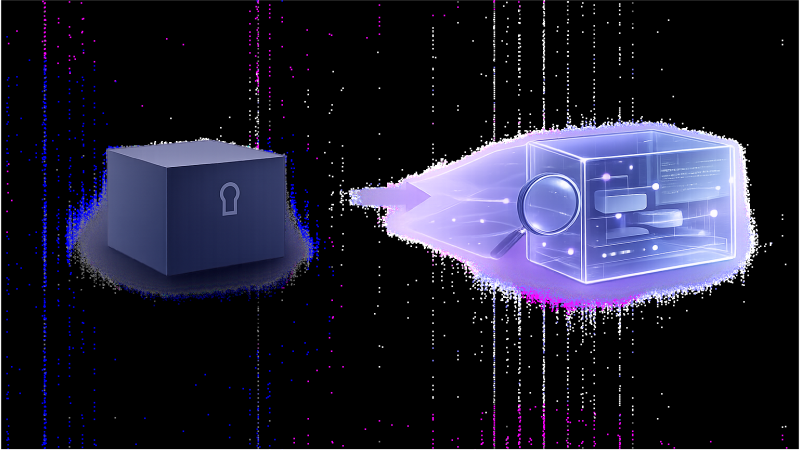
AI You Can Inspect While It’s Thinking
Most AI systems show you what they decided. AuditLens shows you why.
AuditLens is the transparency layer inside the Cognitive OS. It doesn’t just log outputs - it makes the entire decision process visible, traceable, and explainable on demand.
This is not an audit trail bolted on afterward. It’s a glass kitchen.
The Problem AuditLens Solves
You’ve had this moment.
An AI system gives you a response that seems off. Maybe it refused something reasonable. Maybe it took an unexpected direction. Maybe it said something you need to justify to someone else.
You ask: “Why did you respond that way?”
And you get one of three answers:
Vague deflection: “I tried to be helpful while following my guidelines.”
Confabulation: A plausible-sounding explanation that may or may not reflect what actually happened.
Nothing: The system simply can’t tell you.
This isn’t a minor inconvenience. It’s a structural problem.
When you can’t see why an AI made a decision, you can’t:
- Debug when something goes wrong
- Improve based on actual behavior patterns
- Trust that it’s doing what you think it’s doing
- Explain its decisions to regulators, customers, or leadership
- Audit whether it’s operating within policy
Most AI systems are magic shows. Impressive outputs, hidden methods. That works for demos. It fails the moment accountability matters.
The Contrast
| Without AuditLens | With AuditLens |
|---|---|
| ”Why did it say that?” → Shrug | Complete decision trace |
| Trust us | See for yourself |
| Audit logs as afterthought | Transparency by architecture |
| Compliance theater | Genuine explainability |
| Debugging is guesswork | Debugging is visible |
| Magician | Glass Kitchen |
| Impressive results, hidden methods | Watch everything being made |
How AuditLens Works
Transparency by Architecture
AuditLens doesn’t bolt transparency onto a black box. It makes decision-making visible from the start.
Every response has a traceable decision path:
- What did the system understand about the request?
- What options did it consider?
- What tradeoffs did it navigate?
- Why did it choose this approach over alternatives?
A “decision trace” reflects the system’s actual internal decision factors and constraints - not a reconstructed explanation generated afterward.
This information exists because the system generates it as part of its normal operation, not because someone added logging afterward.
Dashboard Levels
AuditLens adapts to how much visibility you need:
| Level | What You See | When to Use |
|---|---|---|
| Disabled | Normal conversation | Default interaction |
| Compact | Key metrics only | Light monitoring |
| Standard | Decision factors visible | Understanding responses |
| Detailed | Full reasoning chain | Debugging, improvement |
| Forensic | Complete audit trail | Compliance, incident review |
Users control their visibility level. The system doesn’t hide behind complexity.
No Behavior Change Under Observation
The same response is generated whether the dashboard is on or off. Transparency doesn’t alter behavior. It reveals it.
A Concrete Scenario
An enterprise deploys AI for customer service. A regulator asks: “Why did the AI recommend this product to this customer?”
Without AuditLens:
The team scrambles. They have chat logs showing what was said. They don’t have decision logs showing why. They ask the AI to explain, but that’s just generating a new response - not revealing the original reasoning. They produce a plausible narrative, but they can’t prove it reflects what actually happened.
With AuditLens:
The team pulls the decision trace. They see:
- What customer signals the system detected
- What product options were considered
- What factors led to the specific recommendation
- What alternatives were rejected and why
- What confidence level the system had
The regulator gets a real answer, not a reconstructed story.
That’s the difference between a magic show and a glass kitchen.
How AuditLens Connects
AuditLens + SafetyMesh
Safety decisions should be explainable. AuditLens exposes why a particular safety level was triggered, what context factors influenced the response, and how trajectory and history affected the decision.
AuditLens + Chronicle
Memory decisions should be visible. AuditLens shows what Chronicle remembered and why, how significance was weighted, and what was forgotten and why.
AuditLens + PRISM
Predictions should be traceable. AuditLens exposes what PRISM predicted about user state, how predictions influenced adaptation, and what confidence levels applied.
AuditLens + ORCHESTRA
Multi-agent decisions need transparency. AuditLens shows which agents contributed what, where disagreements arose, and how synthesis happened.
AuditLens + ProfileForge
Personalization should be inspectable. AuditLens exposes what user patterns were noticed, how those patterns influenced response, and what assumptions the system made.
AuditLens + KnowledgeKernel
When positions influence decisions, AuditLens exposes which KnowledgeKernel stances were applied and why - making the connection between beliefs and behavior visible.
What AuditLens Is Not
AuditLens is not:
- A chat log - it exposes decision architecture, not just conversation history
- Post-hoc rationalization - explanations trace actual decision paths, not generated narratives
- Complete interpretability - it shows decision factors, not raw neural network weights
- A guarantee of correctness - seeing why a decision was made doesn’t mean the decision was right
When AuditLens Matters Most
AuditLens is essential when:
- Regulatory scrutiny applies - healthcare, finance, education, any regulated industry
- Decisions affect people’s lives - recommendations, assessments, approvals, denials
- Trust must be earned, not assumed - enterprise, B2B, high-stakes contexts
- Debugging and improvement matter - production systems that need to get better
- Liability requires documentation - decisions that might be questioned later
The Question You Should Ask
Here’s how to evaluate whether a system has real transparency:
Don’t ask if it has audit logs. Any system can log outputs. That’s not transparency.
Instead, have a substantive conversation with real decisions. Ask the system to explain why it responded the way it did. Push for specifics: “What did you consider? What did you reject?” Ask about a specific tradeoff: “Why this approach instead of that one?”
If the explanation is generic, vague, or could apply to any response, you’re looking at confabulation - not transparency.
If you can trace the specific factors that led to the specific decision, you might be looking at something different.
What to Do Next
→ See It Working and ask it to explain itself
→ Request an audit of a decision you’re curious about
→ Push for specifics - s see if the explanation is traceable or generic
Then ask yourself: “Can I see why this system did what it did? Could I explain it to someone else?”
That’s AuditLens.
| Without AuditLens | With AuditLens |
|---|---|
| "Why did it say that?" → Shrug, trust us, audit logs as afterthought, compliance theater, debugging is guesswork | Complete decision trace, see for yourself, transparency by architecture, genuine explainability, debugging is visible |