
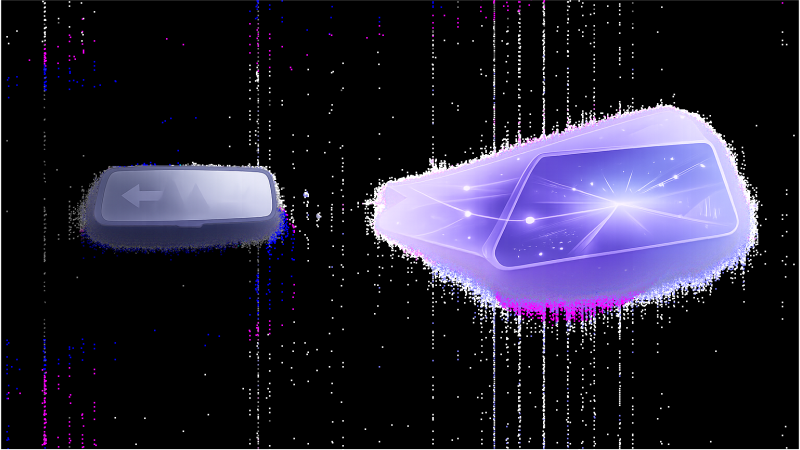
AI That Sees What’s Coming
Most AI systems react to what you said. PRISM anticipates what you need.
PRISM is the predictive adaptation layer inside the Cognitive OS. It watches behavioral signals across a conversation and forecasts where things are headed - not what you’ll say, but how you’re likely to engage. Then it adjusts before problems emerge.
This is not reaction. It’s anticipation.
The Failure Mode PRISM Fixes
You’ve watched this happen.
A learner is struggling. The AI doesn’t notice. The learner struggles more. Finally, the AI adjusts. By then, the learner is frustrated, disengaged, or gone.
This is what happens when AI systems can only see what already happened.
Most AI adaptation works like a rearview mirror. It sees what just occurred and adjusts based on that. User seemed confused? Simplify. User seemed bored? Add complexity. User disengaged? Try something different.
The problem is timing. By the time confusion is visible, frustration has already set in. By the time boredom is obvious, attention has already wandered. By the time disengagement is clear, the user may already be gone.
Reactive adaptation is damage control. It responds to problems after they’ve become problems.
The Contrast
| Without PRISM | With PRISM |
|---|---|
| Responds after struggle | Adjusts before struggle |
| Same approach until failure | Personalized from the start |
| Optimization is hidden | All objectives inspectable |
| Reactive adaptation | Predictive adaptation |
| Sees what already happened | Sees what’s coming |
| Rearview Mirror | Windshield |
| Reacts too late | Adjusts before impact |
PRISM doesn’t wait for problems. It sees them coming.
What PRISM Is
PRISM is predictive behavioral adaptation, not just response generation.
It tracks:
- Engagement trajectory - are you becoming more or less engaged?
- Energy patterns - are you energized or depleted?
- Cognitive load - are you following easily or struggling?
- Affective signals - frustration, curiosity, satisfaction, confusion
- Skill progression - are you learning, plateauing, or regressing?
It predicts across multiple horizons:
- +1 turn: >85% accuracy - what you’ll likely need next
- +3 turns: >70% accuracy - where this conversation is heading
- +5 turns: >60% accuracy - longer-term trajectory
Accuracy varies by domain, user, and interaction length - and is continuously recalibrated.
It adapts through multiple levers:
- Tone and warmth
- Pacing and rhythm
- Complexity and depth
- Structure and scaffolding
- Challenge level
- Support density
PRISM’s principle is simple: The best adjustment is the one you never have to ask for.
What PRISM Is Not
- Mind reading - it predicts behavior, not thoughts
- Guaranteed accuracy - probabilities, not certainties
- Unconstrained - SafetyMesh can veto any adaptation
- Hidden manipulation - all objectives are declared and inspectable
- Intent inference - PRISM does not infer motives, desires, or internal states beyond observable interaction signals
- Useful for single-turn Q&A - prediction needs trajectory
A Concrete Scenario
The Student Who’s Falling Behind
A high school student is working through a math lesson. The AI notices response times increasing, confidence language decreasing, and error patterns suggesting a foundational gap.
Without PRISM:
The AI continues at the same pace. The student falls further behind. Eventually, the student says “I don’t get this.” The AI backtracks - but the student has already been struggling for ten minutes. Frustration has built. The session feels like failure.
With PRISM:
Four turns before the student would have said anything, PRISM predicts the trajectory: engagement dropping, confusion building, likely foundational gap.
The AI adjusts preemptively: slows pacing, adds scaffolding, gently checks the foundation. The student doesn’t have to admit they’re lost. The support arrives before the frustration builds.
That’s the difference between a rearview mirror and a windshield.
How PRISM Connects
PRISM + ProfileForge
Prediction becomes personalized. PRISM uses ProfileForge to calibrate predictions to individual patterns - recognizing what “low engagement” means for this specific user.
PRISM + Chronicle
Memory informs prediction. PRISM uses Chronicle to track patterns across sessions and recognize recurring trajectories (“this user often loses steam around turn 15”).
PRISM + SafetyMesh
Prediction serves safety. PRISM informs SafetyMesh by predicting risk trajectories before they arrive, enabling preemptive safety posture adjustment.
PRISM + PersonaForge
Adaptation needs consistent voice. PRISM coordinates with PersonaForge to adjust within persona boundaries - more warmth without becoming a different personality.
PRISM + AuditLens
Prediction should be inspectable. AuditLens exposes what PRISM predicted, what adaptations were triggered, and why specific adjustments were chosen.
The Question You Should Ask
Here’s how to evaluate whether a system has real predictive adaptation:
Don’t ask if it “personalizes.” Every AI claims personalization. Few deliver it dynamically.
Instead:
- Have a sustained conversation with natural fluctuations in your engagement
- Don’t explicitly announce when you’re struggling or losing interest
- Observe whether the system notices and adapts - or stays static
- Ask: “Did the adjustment come before I had to ask for it?”
If adaptation only happens after you explicitly request it, you’re looking at a rearview mirror.
If it happens before - if the system seems to see what’s coming - you might be looking at a windshield.
What to Do Next
→ See it working with a sustained conversation, not just quick questions
→ Let your engagement naturally fluctuate - don’t announce changes
→ Notice when adjustment happens - before you ask, or after?
Then ask yourself: “Did this system anticipate what I needed? Or just react to what I said?”
That’s PRISM.
| Without PRISM | With PRISM |
|---|---|
| Responds after struggle · Same approach until failure · Optimization is hidden · Reactive adaptation · Sees what already happened | Adjusts before struggle · Personalized from the start · All objectives inspectable · Predictive adaptation · Sees what's coming |