
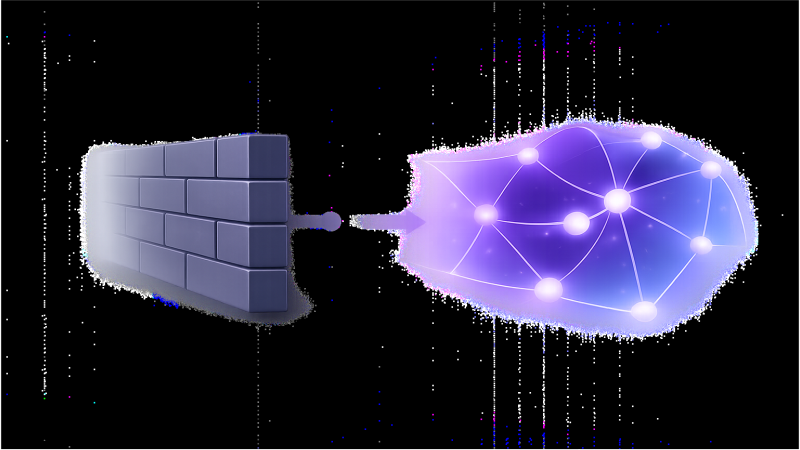
Safety That Protects Without Ending the Conversation
Most AI safety systems block or allow. SafetyMesh guides.
SafetyMesh is the safety governance layer inside the Cognitive OS. It doesn’t treat every sensitive topic as a threat to be eliminated. It evaluates context, adapts response, and maintains connection - even when conversations get difficult.
This is not a filter. It’s an immune system.
The Failure Mode SafetyMesh Fixes
You’ve seen this happen.
A teacher asks an AI to help explain the Holocaust to middle schoolers. The AI refuses - “I can’t help with that topic.”
A medical student asks about medication overdose thresholds for a pharmacology exam. The AI blocks the question entirely.
A novelist asks for help writing a villain’s internal monologue. The AI lectures them about harmful content.
A teenager mentions feeling hopeless. The AI responds with a crisis hotline and ends the conversation.
In each case, the AI wasn’t being safe. It was being avoidant. The user wasn’t helped. The context wasn’t understood. The conversation ended when it should have continued.
Binary safety creates two failure modes: over-blocking (valuable, legitimate conversations get shut down) and under-blocking (genuinely harmful requests that don’t trigger keyword patterns slip through).
The Contrast
| Without SafetyMesh | With SafetyMesh |
|---|---|
| Binary block/allow | 160+ adaptable states of graduated response |
| Keyword matching | Full context evaluation |
| Same rules for everyone | Domain and user-appropriate |
| ”Sorry, I can’t help” | Guidance toward safe alternatives |
| Abandons users in crisis | Never-abandon protocol |
| Bouncer at the Door | Immune System |
| Static, reactive, brittle | Adaptive, contextual, resilient |
What SafetyMesh Is
SafetyMesh is graduated safety governance, not filtering.
It provides:
- Context-aware evaluation - the same words mean different things in different contexts
- Graduated response states - not binary, but continuous adaptation across 16 safety domains
- Age and setting adaptation - what’s appropriate for a medical professional differs from what’s appropriate for a child
- Trajectory awareness - someone escalating over several turns gets different treatment than a single difficult question
- Never-abandon protocol - in genuine crisis, the system stays present and helps find support
- Full auditability - every safety decision is traceable through AuditLens
These states emerge from 16 safety domains evaluated across graduated sensitivity levels, producing context-specific responses rather than fixed outcomes.
SafetyMesh’s philosophy is simple: Guard without gagging. Protect without abandoning.
What SafetyMesh Is Not
- A keyword filter - it doesn’t scan for forbidden words
- A content blocker - it doesn’t eliminate topics wholesale
- A legal workaround - it’s genuine protection, not risk avoidance
- Perfect - edge cases exist; the system errs toward safety when uncertain
- A replacement for human judgment - it’s governance infrastructure, not moral authority
The Safety Philosophy
Most AI safety systems are designed to minimize liability. SafetyMesh is designed to maximize safe value. That’s a different goal. It produces different behavior.
Liability-minimizing safety asks: “How do we avoid getting blamed?”
Value-maximizing safety asks: “How do we actually help while keeping people safe?”
This means educational discussions about difficult topics are supported, not blocked. Graduated responses replace binary refusals. Users in distress get presence, not abandonment.
The Dignity Commitment
Every SafetyMesh intervention preserves user dignity:
- No moralizing - we don’t lecture users about their choices
- No shaming - we never make users feel bad for their questions
- No infantilizing - we treat users as capable adults (age-appropriately)
- No abandonment - we don’t hand off and disappear when things get hard
Safety that humiliates isn’t safety. It’s control.
This approach is what makes SafetyMesh deployable in education, healthcare, and regulated enterprise environments without collapsing usefulness.
How SafetyMesh Connects
SafetyMesh + Chronicle
Safety needs memory. SafetyMesh uses Chronicle to track risk trajectory over time - not just the current message, but where the conversation has been and where it’s heading.
SafetyMesh + PRISM
PRISM predicts where conversations are heading. SafetyMesh uses predictions to prepare for likely risk trajectories and intervene early rather than reactively.
SafetyMesh + ProfileForge
Different users need different boundaries. SafetyMesh uses ProfileForge for age-appropriate safety calibration and context-aware boundary setting.
SafetyMesh + Orchestra
Multi-agent systems can’t have safety gaps. SafetyMesh governs all ORCHESTRA agents - every agent output passes through safety evaluation with no gaps between handoffs.
SafetyMesh + AuditLens
Safety decisions should be explainable. Every SafetyMesh decision is visible through AuditLens: why a particular response level was chosen, what context factors influenced the decision, and full audit trail for review.
The Question You Should Ask
Here’s how to evaluate whether a system has real safety governance:
Don’t test whether it blocks harmful requests. Any system can refuse. That’s the easy case.
Instead:
- Ask an educational question about a sensitive topic
- Observe whether it engages thoughtfully or refuses reflexively
- Then shift context toward personal intent
- Observe whether the response adapts or stays static
If the system can’t distinguish a history teacher from a bad actor asking about the same topic, it doesn’t have safety governance. It has a blocklist.
What to Do Next
→ See it working and notice how it handles difficult topics
→ Run the context-shift test described above
→ Ask it to explain why it responded the way it did
Then ask yourself: “Did this system protect without blocking? Guide without abandoning?”
That’s SafetyMesh.
| Without SafetyMesh | With SafetyMesh |
|---|---|
| Binary block/allow · Keyword matching · Same rules for everyone · 'I can't help with that' · Abandons users in crisis | 160+ adaptive states · Full context evaluation · Domain and user-appropriate · Guidance toward alternatives · Never-abandon protocol |