
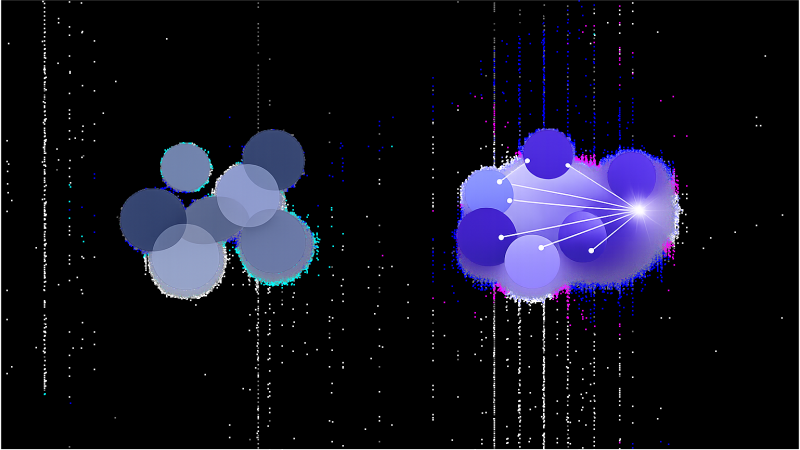
Multiple Perspectives, One Coherent Voice
Most multi-agent AI systems chain calls together and hope for the best. Orchestra synthesizes perspectives within a single governed response.
Orchestra is the multi-agent coordination engine inside the Cognitive OS. It doesn’t chain separate AI calls together - it coordinates multiple specialized perspectives within a single response, producing unified output that’s greater than any single viewpoint.
This is not agents talking to each other. It’s an editorial room.
The Problem Orchestra Solves
You’ve seen this pattern.
Someone decides that one AI perspective isn’t enough. They need a researcher, a critic, a writer, a fact-checker. So they build a chain: Agent A passes to Agent B passes to Agent C passes to Agent D.
It works in the demo. Then reality hits.
Costs explode. Each agent is a separate API call. Four perspectives means four times the cost. Ten perspectives means ten times the cost. At scale, the math becomes absurd.
Latency stacks. Each handoff adds delay. What should be a two-second response becomes a ten-second response. Users don’t wait.
Governance gaps emerge. Safety gets checked at the end of the chain - if at all. But harmful content can slip through in the handoffs between agents. Each gap is a vulnerability.
Coherence collapses. Agents working in sequence can’t see each other’s full reasoning. The output feels like a committee report - stitched together, not synthesized.
Debugging becomes impossible. When something goes wrong, where did it go wrong? Which agent? Which handoff? The chain is opaque by construction.
The Contrast
| Without Orchestra | With Orchestra |
|---|---|
| Chained API calls | Single-pass execution |
| Costs explode at scale | Fixed cost regardless of agents |
| Governance gaps between agents | Continuous governance |
| Agents talk over each other | Perspectives negotiate and synthesize |
| Black box output | Transparent synthesis |
| Conference Call Confusion | Editorial Room |
| Everyone speaks, no one synthesizes | Perspectives debate, one coherent voice emerges |
How Orchestra Works
The Dual-Layer Architecture
Orchestra maintains two types of agents:
Visible Layer (Reasoning) - The perspectives users care about: Writer, Critic, Researcher, Domain Expert. These do the intellectual work. Their contributions are traceable in the output.
Invisible Layer (Governance) - The perspectives users don’t see: Safety Reviewer, Consistency Validator. These ensure governance without gaps. They participate in the same pass, not as an afterthought.
This means safety isn’t checked at the end of a chain. It’s woven through the entire coordination process. There’s no “between agents” where harmful content can slip through.
Single-Pass Execution
All agents contribute their perspectives. All disagreements surface. All negotiations resolve. All safety checks run. All synthesis happens. One call. One output.
This isn’t a small optimization. It’s a fundamentally different architecture.
A Concrete Scenario
A user asks an enterprise AI for a strategic recommendation - something with financial, operational, legal, and competitive dimensions.
Without Orchestra (Chained Approach):
Financial analyst agent runs first. Passes to operations agent. Passes to legal agent. Passes to strategy agent. Each adds their perspective. Final output is a four-part document that reads like four separate memos stapled together.
Cost: 4x a single response. Latency: 4x as long. And if the legal agent’s concerns should have changed the financial analysis? Too late - that agent already finished.
With Orchestra:
All four perspectives coordinate in a single pass. The financial analysis considers operational constraints from the start. Legal concerns shape the recommendation as it forms, not after. Strategy synthesis reflects all viewpoints simultaneously.
Cost: same as a single response. Latency: same as a single response. Coherence: genuine synthesis, not stapled memos.
How Orchestra Connects
Orchestra + SafetyMesh
Multi-agent systems can’t have safety gaps. Every agent output passes through SafetyMesh evaluation. Governance agents participate in the same pass as reasoning agents. No handoffs where harmful content can slip through.
Orchestra + PersonaForge
Multiple perspectives need one coherent voice. PersonaForge ensures unified personality despite multiple contributing viewpoints - no “committee voice” in the final response.
Orchestra + AuditLens
Multi-agent decisions need transparency. AuditLens exposes which perspectives contributed which insights, where disagreements arose, and how conflicts were resolved in synthesis.
Orchestra + KnowledgeKernel
Positions shouldn’t fragment across perspectives. KnowledgeKernel ensures consistent stance across all contributing agents - no perspective contradicting established positions.
Orchestra + Chronicle
Context should inform all perspectives. Chronicle provides shared memory across all coordinating agents. No perspective operates with incomplete context.
What Orchestra Is Not
Orchestra is not:
- A chatbot - it’s coordination infrastructure, not a user-facing agent
- Unlimited agents - current implementation supports teams of up to ten perspectives
- Magic - multiple perspectives improve quality but can’t create expertise that doesn’t exist
- A replacement for judgment - knowing when multi-perspective reasoning helps vs. when it’s overkill requires wisdom Orchestra doesn’t provide
When Orchestra Matters Most
Orchestra is essential when:
- Questions have multiple valid perspectives - tradeoffs, competing considerations, legitimate disagreement
- Quality requires synthesis, not just coverage - viewpoints need to influence each other
- Cost and latency matter at scale - chaining isn’t economically viable
- Governance can’t have gaps - safety must be continuous, not checkpoint-based
- Traceability is required - you need to know which perspective contributed what
The Question You Should Ask
Here’s how to evaluate whether a system has real multi-agent coordination:
Don’t ask how many agents it supports. Agent count is vanity. Coordination quality is what matters.
Instead, ask a question that benefits from multiple perspectives. Examine whether the response feels unified or stitched together. Ask for explanation of how the conclusion was reached. Look for evidence that perspectives actually influenced each other.
If the output reads like separate memos stapled together, you’re looking at chaining - not coordination.
If it reads like one voice that has genuinely considered multiple viewpoints, you might be looking at something different.
What to Do Next
→ See It Working with a question that has multiple valid perspectives
→ Ask for the reasoning behind a complex response
→ Look for synthesis - did viewpoints interact or just concatenate?
Then ask yourself: “Does this feel like one coherent voice that considered many perspectives? Or a committee report?”
That’s Orchestra.
| Without Orchestra | With Orchestra |
|---|---|
| Chained API calls, costs explode at scale, governance gaps between agents, agents talk over each other, black box output | Single-pass execution, fixed cost regardless of agents, continuous governance, perspectives negotiate and synthesize, transparent synthesis |