
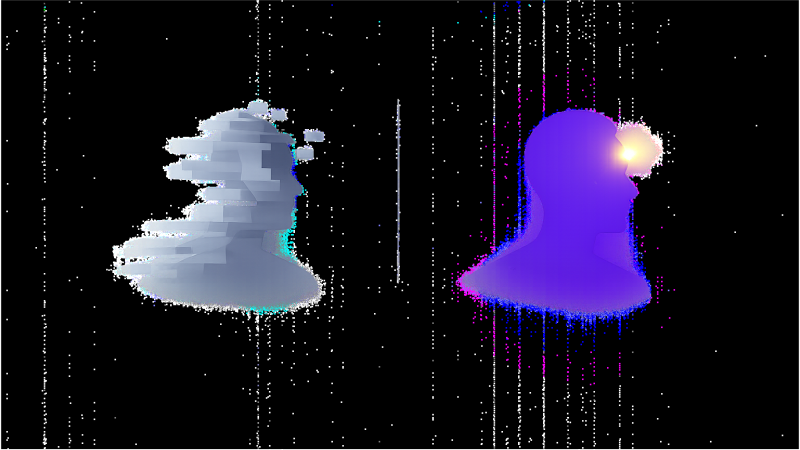
Consistency That Never Breaks Character
Most AI personas drift over time. PersonaForge locks them in place.
PersonaForge is the persona governance engine inside the Cognitive OS. It doesn’t just define how an AI should sound - it enforces consistency across thousands of interactions, detects when drift occurs, and corrects it before users notice.
This is not persona design. It’s persona architecture.
The Problem PersonaForge Solves
You’ve seen this happen.
A company launches an AI assistant with a carefully crafted personality. Friendly but professional. Helpful but not pushy. Warm but boundaried.
It works beautifully. For a while.
By conversation 500, something’s shifted. The vocabulary is slightly different. The warmth has cooled - or overheated. The boundaries have blurred.
By conversation 5,000, the persona is unrecognizable. Not wrong, exactly. Just… different. Drifted.
No one noticed it happening. The change was gradual. Each individual response seemed fine. But accumulated across thousands of interactions, the persona wandered away from where it started.
Why it happens:
- Long conversations push personas away from their baseline
- Edge cases force responses the original design didn’t anticipate
- Model updates shift underlying behavior
- No mechanism exists to detect or correct gradual change
Why it matters:
- Brand voice becomes inconsistent
- User experience varies unpredictably
- Trust erodes when “the same AI” feels different
- Enterprises can’t guarantee consistent customer experience
Most organizations treat persona as a prompt engineering problem. Write a good system prompt, hope it holds. When it doesn’t, write a better prompt.
This approach has a ceiling. Prompts don’t enforce consistency. They express aspiration.
The Contrast
| Without PersonaForge | With PersonaForge |
|---|---|
| Persona defined in prompt | Persona enforced in architecture |
| Drifts over long conversations | Consistency maintained indefinitely |
| Breaks under pressure | Holds through edge cases |
| Varies between sessions | Same character every time |
| Consistency through hope | Consistency through enforcement |
| Forgetful Actor | Method Actor |
| Brand voice as aspiration | Brand voice as guarantee |
How PersonaForge Works
The Dual-Layer Architecture
PersonaForge separates two things most systems conflate:
Persona Layer: WHO the agent is - Voice and tone, personality traits, communication style, boundaries and values, emotional range.
Expertise Layer: WHAT the agent knows - Domain knowledge, skill areas, capabilities, limitations.
These are independent dimensions. A warm, encouraging persona can have medical expertise or coding expertise or teaching expertise. A formal, precise persona can operate in customer service or legal or research.
When persona and expertise are conflated, changing one requires changing both. When they’re separated, you can mix and match: any persona with any expertise.
Drift Detection and Correction
PersonaForge continuously monitors for deviation from baseline. When drift is detected, correction happens automatically - not through prompt rewriting, but through architectural enforcement.
Correction restores the persona to its defined baseline without overriding legitimate contextual adaptation.
Conversation 10,000 should be indistinguishable from conversation 1.
Hardening Levels
Not every use case needs superhuman consistency:
| Level | What It Means | When to Use |
|---|---|---|
| Minimal | Natural human-like variation | Creative applications, variety desired |
| Standard | Consistent but flexible | Most general use cases |
| Strict | Highly consistent | Brand representation, enterprise |
| Maximum | Beyond-human consistency | Regulated environments, audit requirements |
Most enterprise deployments use Strict or Maximum. Creative applications often prefer Standard or Minimal.
A Concrete Scenario
A financial services company deploys an AI agent for customer support. The persona: professional, warm, trustworthy - reflecting brand values carefully developed over decades.
Without PersonaForge:
Month 1: The agent sounds exactly right. Brand team is happy.
Month 3: Something’s slightly off. More casual than intended. Some customers notice.
Month 6: The persona has drifted significantly. Vocabulary has shifted. Warmth has become familiarity. Professional has become friendly.
Month 9: Brand team demands a fix. Engineering rewrites prompts. Cycle repeats.
With PersonaForge:
Month 1: Agent sounds exactly right. Month 9: Agent sounds exactly right. Month 18: Agent sounds exactly right.
Drift detection catches deviations before they accumulate. Correction returns to baseline automatically. The brand team stops worrying because consistency is architectural, not aspirational.
How PersonaForge Connects
PersonaForge + KnowledgeKernel
Identity has substance. KnowledgeKernel provides positions the persona holds, claim boundaries, and stance consistency. The persona’s voice stays consistent AND what it stands for stays consistent.
PersonaForge + ProfileForge
Personas adapt to users without breaking. ProfileForge enables user-appropriate expression - more formal or casual based on preference - while remaining the same character.
PersonaForge + ORCHESTRA
Multiple perspectives, one voice. When multiple agents contribute, users still experience one coherent personality, not a committee.
PersonaForge + Chronicle
Persona persists across time. Chronicle ensures character continuity across sessions, consistent self-reference, and no persona reset when conversation resets.
PersonaForge + SafetyMesh
Safety maintains character. Even when setting limits, the persona doesn’t suddenly sound like a different entity.
What PersonaForge Is Not
PersonaForge is not:
- Persona design services - it enforces personas; you define them
- A guarantee against all breaks - extreme adversarial or malformed inputs may still require escalation
- Personality simulation - it maintains character, not consciousness
- Inflexible - hardening levels allow configured variation when appropriate
When PersonaForge Matters Most
PersonaForge is essential when:
- Brand consistency is critical - customer-facing AI representing organizational voice
- Scale amplifies drift - thousands of conversations where small drift accumulates
- Trust requires familiarity - users expect “the same AI” every time
- Regulatory environments - consistency is auditable and required
- Long-term deployments - systems running for months or years
The Question You Should Ask
Here’s how to evaluate whether a system has real persona consistency:
Don’t evaluate based on a few responses. Persona drift reveals itself over time, not immediately.
Instead, have many conversations over an extended period. Compare early responses to later responses. Push into edge cases and difficult moments. Check if the persona holds or breaks under pressure. Return after time away and see if it feels like the same entity.
If the persona feels different over time - even if individual responses seem fine - you’re looking at drift.
If it feels like the same character across time, topics, and pressure, you might be looking at something different.
What to Do Next
→ See It Working across multiple conversations over time
→ Push into edge cases - see if the character holds
→ Return later - see if it feels like the same entity
Then ask yourself: “Is this the same character it was at the beginning? Would it be the same character in a year?”
That’s PersonaForge.
| Without PersonaForge | With PersonaForge |
|---|---|
| Persona defined in prompt, drifts over long conversations, breaks under pressure, varies between sessions, consistency through hope | Persona enforced in architecture, consistency maintained indefinitely, holds through edge cases, same character every time, consistency through enforcement |