
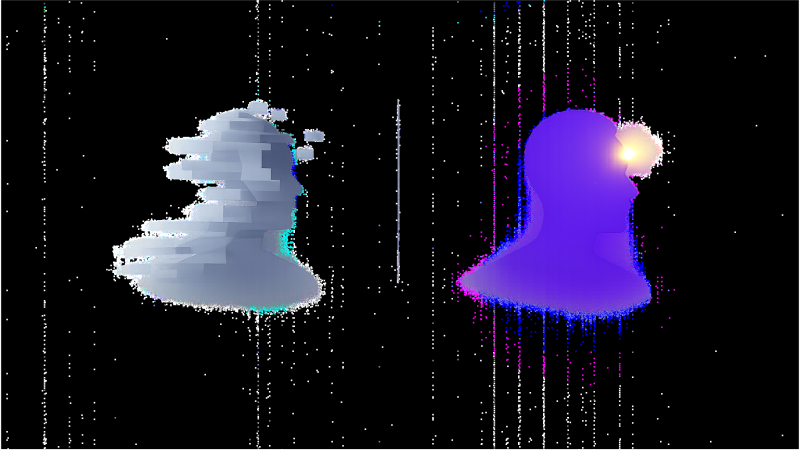
You’ve built an AI persona.
It starts perfectly on-brand. The tone is right. The vocabulary fits. The personality feels exactly like what you designed.
Then, somewhere around conversation 500, something shifts. The vocabulary drifts. The warmth fades. The carefully crafted voice starts sounding… generic.
Nobody noticed when it happened. Everyone notices when customers complain.
This is what happens when consistency depends on prompts instead of architecture.
The Problem With Prompt-Based Personas
Most AI personas are built on a simple model: write a detailed prompt describing who the AI should be, and hope the model follows it.
Hope is not a strategy.
Over long conversations, prompts fade. The model’s underlying patterns reassert themselves. Tone shifts. Vocabulary wanders. The persona you designed slowly dissolves into the model’s default behavior.
Teams try to fight this with longer prompts, more detailed instructions, constant reminders. It helps for a while. Then drift happens anyway.
The fundamental problem is that prompts are suggestions. They’re not constraints. The model can follow them, ignore them, or gradually drift away from them. There’s nothing in the architecture that enforces consistency.
Forgetful Actor vs. Method Actor
Think about two types of actors.
A forgetful actor relies on cues. They read the script, remember their lines, and perform the role. But between scenes, they slip. They check their phone, chat with the crew, drop out of character. When cameras roll again, they have to reconstruct the persona from scratch. Over a long shoot, the performance drifts. Early scenes and late scenes don’t quite match.
A method actor embodies the role. They don’t drop character between scenes. The persona isn’t something they put on and take off. It’s something they inhabit continuously. Scene 500 is indistinguishable from scene 1 because the character was never abandoned.
Prompt-based personas are forgetful actors. PersonaForge creates method actors.
| Forgetful Actor | Method Actor |
|---|---|
| Drifts over long conversations | Never drifts |
| Consistency through hope | Consistency through architecture |
| Persona = expertise (locked together) | Persona ≠ expertise (mix and match) |
| Conversation 10,000 ≠ conversation 1 | Conversation 10,000 = conversation 1 |
| Brand voice as aspiration | Brand voice as guarantee |
What Architectural Consistency Actually Means
PersonaForge enforces consistency at the system level, not the prompt level.
Drift detection monitors vocabulary patterns, tone, and behavior across every interaction. When the system detects deviation from the persona baseline, it corrects automatically. Not after thousands of conversations. Not when someone notices. Immediately.
Correction doesn’t rewrite history - it re-centers future responses around the defined baseline.
Hardening controls let you configure how strictly consistency is enforced. Some contexts benefit from natural variation. Others require absolute precision. You choose the level that fits your use case.
The result: conversation 10,000 sounds like conversation 1. Not because you’re hoping the prompt holds, but because the architecture enforces it.
The Persona-Expertise Split
Here’s something most persona systems get wrong: they lock personality and knowledge together.
Want a warm, friendly expert? Build one persona. Want a formal, rigorous expert? Build a different persona. Same knowledge, different delivery? Rebuild from scratch.
PersonaForge separates these dimensions. WHO the agent is (persona) is independent of WHAT it knows (expertise). You can pair any personality with any knowledge domain.
A warm teacher and a stern teacher can share the same expertise module. They know the same things. They explain them differently.
This means combinatorial flexibility instead of exponential persona sprawl. Create personalities. Create expertise modules. Mix and match as needed.
A Different Kind of Interaction
Here’s what this looks like in practice.
Prompt-based system:
- Month 1: Persona launches. Tone is perfect. Vocabulary is on-brand.
- Month 3: Slight drift. Still recognizable, but something’s different.
- Month 6: Significant drift. Customers notice inconsistency.
- Month 9: Complete rebuild required. Start over.
PersonaForge system:
- Month 1: Persona launches. Tone is perfect. Vocabulary is on-brand.
- Month 3: Drift detection catches minor deviation. Auto-correction applied.
- Month 6: Same voice. Same warmth. Same vocabulary patterns.
- Month 9: Same voice. Indistinguishable from month 1. No rebuild required. Ever.
The second approach isn’t just more consistent. It’s more efficient. You build the persona once. The architecture maintains it.
Beyond Human Consistency
Here’s something most people don’t consider: humans aren’t perfectly consistent either.
Human customer service representatives have good days and bad days. Their energy varies. Their patience fluctuates. This is normal and expected.
But sometimes you need more consistency than humans provide.
A regulatory environment where every interaction must meet the same standard. A brand presence that can’t afford variance. A therapeutic context where stability itself is part of the value.
PersonaForge offers hardening levels that can exceed human consistency when the context requires it. Not as a replacement for human judgment, but as an option when superhuman reliability serves the use case.
What PersonaForge Is Not
PersonaForge is not persona design services. It enforces personas you define. The creative work of deciding who the AI should be remains with you.
It provides enforced consistency within defined tolerance bounds, configurable by use case. Extreme edge cases may challenge consistency. Hardening levels determine how strictly the system maintains baseline behavior.
It’s not personality simulation. PersonaForge maintains character, not consciousness. The persona is a defined behavioral pattern, not an emerging identity.
And it’s not suitable for every context. If you want natural variation, or if single-turn interactions don’t require character consistency, simpler approaches may suffice.
How PersonaForge Connects
Consistent persona requires coordination with everything else.
PersonaForge + KnowledgeKernel - Identity has substance. The persona’s voice stays consistent AND what it stands for stays consistent.
PersonaForge + ProfileForge - Personas adapt to users without breaking. The system can be warmer with users who prefer warmth - while remaining the same character.
PersonaForge + ORCHESTRA - Multiple perspectives, one voice. Users experience one coherent personality even when multiple agents contributed.
PersonaForge + Chronicle - Persona persists across time. The same character across sessions, not just within a session.
PersonaForge + SafetyMesh - Safety maintains character. Even when setting limits, the persona doesn’t suddenly sound like a different entity.
This integration is what makes PersonaForge enterprise-ready. Consistency that isn’t governed, adaptive, and persistent creates brittleness. Consistency that is creates reliability.
The Deeper Shift
The industry has spent years treating personas as prompt engineering problems.
PersonaForge represents a shift toward treating personas as architectural problems. Not “how do we write a better prompt?” but “what system constraints are required to guarantee consistency?”
That’s a fundamentally different question. It produces fundamentally different results.
How to Tell If Consistency Is Real
You don’t need to see the architecture. Just observe over time:
Does the persona sound the same in month 6 as month 1? When drift happens, is it caught immediately or discovered by customers? Can you configure how strict consistency should be?
If consistency depends on hope, you’re looking at a forgetful actor.
If consistency depends on architecture, you might be looking at a method actor.
What to Do Next
→ See PersonaForge in action across multiple conversations over time
→ Push into edge cases - see if the character holds
→ Return later - see if it feels like the same entity
Then ask yourself: “Is this the same character it was at the beginning? Would it be the same character in a year?”
That’s PersonaForge.
PersonaForge is part of the Cognitive OS, the missing operating system layer for AI.
Next: AuditLens - Why AI decisions feel like magic tricks, and what transparency actually requires.