
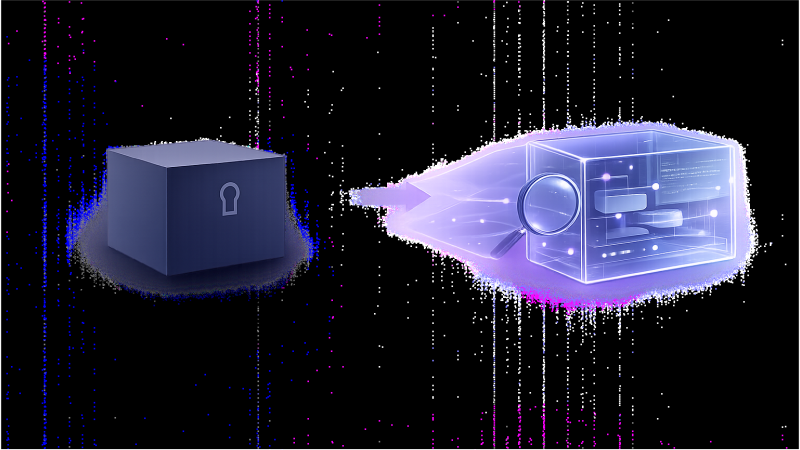
A regulator asks: “Why did the AI recommend this?”
Your team looks at each other. Someone pulls up logs. The logs show inputs and outputs, but nothing in between. The model made a decision. Nobody can explain why.
“Our model determined that this was the optimal recommendation based on the available data.”
The regulator is not satisfied. Neither are you.
This is what happens when AI operates like a magician instead of a glass kitchen.
The Problem With Black Box AI
Most AI systems produce impressive results through hidden methods.
You see the input. You see the output. Everything in between is invisible. When the output is good, nobody asks questions. When the output is wrong, surprising, or needs to be justified, there’s nothing to show.
Teams try to solve this with logging. They capture inputs, outputs, timestamps, metadata. But logs are archaeology. They tell you what happened, not why. They’re generated after the fact, designed for storage and retrieval, not for explanation.
The fundamental problem is that transparency wasn’t part of the design. It was bolted on afterward. And bolted-on transparency is compliance theater, not genuine explainability.
The Difference Between Magician and Glass Kitchen
Think about how a magician and a glass kitchen create different relationships with their audiences.
A magician produces impressive results through hidden methods. That’s the point. The magic depends on not seeing how it’s done. You’re supposed to be amazed, not informed. If you ask “how did you do that?”, the magician smiles and changes the subject.
A glass kitchen operates on the opposite principle. The chef works in full view. You watch ingredients being selected, techniques being applied, decisions being made. When the dish arrives, you understand how it came to be. If you have questions, the chef can point to specific moments in the process.
Most AI systems are magicians. AuditLens creates glass kitchens.
| Magician | Glass Kitchen |
|---|---|
| ”Why did it say that?” → Shrug | Complete decision trace |
| Trust us | See for yourself |
| Audit logs as afterthought | Transparency by architecture |
| Compliance theater | Genuine explainability |
| Debugging is guesswork | Debugging is visible |
What Transparency by Architecture Actually Means
AuditLens doesn’t bolt transparency onto a black box. It makes decision-making visible from the start.
Every response has a traceable decision path. What did the system understand about the request? What options did it consider? What tradeoffs did it navigate? Why did it choose this approach over alternatives?
This information exists because the system generates it as part of its normal operation, not because someone added logging afterward. The transparency is architectural, not cosmetic.
Users control how much they see. Most of the time, the system operates invisibly. When you want to understand a decision, you ask. The information is always there. It’s just not always displayed.
A Different Kind of Interaction
Here’s what this looks like in practice.
Magician system:
User: “Why did you recommend Option B instead of Option A?”
AI: “Based on my analysis of the situation, Option B appeared to be the better choice.”
User: “But why? What factors did you weigh?”
AI: “I considered multiple factors including relevance, risk, and alignment with your stated goals.”
User: “Can you be more specific?”
AI: “I’m sorry, I don’t have access to the detailed reasoning that led to that recommendation.”
Glass kitchen system:
User: “Why did you recommend Option B instead of Option A?”
AI: “Here’s the decision trace:
- Intent detected: Seeking recommendation for [context]
- Options considered: A, B, C
- Option A: Strong on cost, weak on timeline risk
- Option B: Moderate on cost, strong on timeline and your stated priority of speed
- Option C: Eliminated due to regulatory concerns
- Tradeoff resolved: Prioritized your speed requirement over cost optimization
- Confidence: 0.82”
The second response doesn’t require trust. It provides evidence. The user can agree with the reasoning, challenge it, or ask for different weights. The conversation can progress because the logic is visible.
Progressive Disclosure
Not everyone needs the same level of detail all the time.
AuditLens provides multiple dashboard levels. Off shows nothing - just normal conversation. Compact shows a single line of key metrics. Standard shows structured decision information. Detailed shows full reasoning traces. Forensic shows everything, including alternatives considered and rejected - this level is permissioned for audit and regulatory contexts.
You choose what fits the moment. Casual conversation? Dashboard off. Surprising response you want to understand? Ask for the trace. Regulatory audit? Forensic mode shows the complete picture.
The information is always there. Visibility is your choice.
What AuditLens Is Not
AuditLens is not a logging system. Logs record what happened for later retrieval. AuditLens makes reasoning visible in real time as part of the response itself.
It’s not mind-reading. AuditLens shows the decision process, not the underlying model weights or training data. It explains reasoning at the level of strategy and tradeoffs, not at the level of neural network internals. AuditLens exposes decision structure and tradeoffs - not raw chain-of-thought tokens.
It’s not infallible. The system reports what it understands about its own decision-making. This is genuine transparency, but it’s transparency about a process that still involves uncertainty and estimation.
And it doesn’t change the response. AuditLens is observation only. The same response is generated whether the dashboard is on or off. Transparency doesn’t alter behavior. It reveals it.
How AuditLens Connects
Transparency only matters if it extends across the whole system.
AuditLens integrates with:
ORCHESTRA: Full trace through multi-agent negotiation. When multiple perspectives contribute, you can see which agent said what, where disagreements arose, and how synthesis resolved them.
SafetyMesh: Safety decisions explainable. When the system sets boundaries, you can see why.
PRISM: Prediction reasoning visible. When the system anticipates and adapts, you can see the prediction and the adaptation logic.
Chronicle: Historical behavior explainable. When the system remembers something, you can see what was remembered and why it was considered significant.
This integration is what makes AuditLens enterprise-ready. Transparency that only covers part of the system creates gaps. Transparency that covers everything creates trust.
The Deeper Shift
The industry has spent years building AI systems optimized for impressive outputs.
AuditLens represents a shift toward AI systems optimized for understandable outputs. Not “did it produce something good?” but “can we explain why it produced what it did?”
That’s a fundamentally different design goal. It produces fundamentally different relationships between AI systems and the people who use, regulate, and depend on them.
How to Tell If Transparency Is Real
You don’t need to see the architecture. Just ask:
When you ask “why?”, do you get a real answer or a deflection? Can you see the tradeoffs that were navigated? Can you trace decisions back to their reasoning? Does the explanation feel like evidence or marketing?
If transparency feels like a magic trick explanation, you’re still looking at a magician.
If it feels like watching a chef work, you might be looking at a glass kitchen.
AuditLens is part of the Cognitive OS, the missing operating system layer for AI.