
You’ve watched this happen.
A learner is struggling. The AI doesn’t notice. The learner struggles more. Finally, the AI adjusts. By then, the learner is frustrated, disengaged, or gone.
This is what happens when AI systems can only see what already happened.
The Problem With Reactive AI
Most AI adaptation works like a rearview mirror. It sees what just occurred and adjusts based on that.
User seemed confused? Simplify. User seemed bored? Add complexity. User disengaged? Try something different.
The problem is timing. By the time confusion is visible, frustration has already set in. By the time boredom is obvious, attention has already wandered. By the time disengagement is clear, the user may already be gone.
Reactive adaptation is damage control. It responds to problems after they’ve become problems. It’s better than no adaptation at all, but it’s fundamentally limited by what it can see: the past.
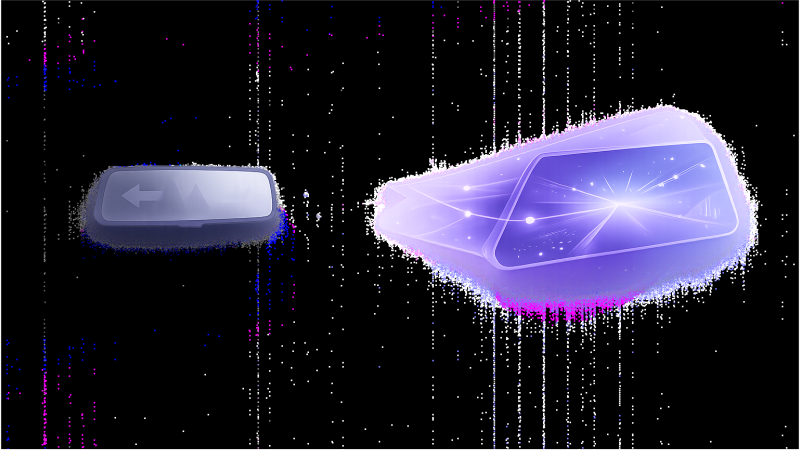
Rearview Mirror vs. Windshield
Think about driving.
A rearview mirror shows you what already happened. Useful for some things, but you can’t navigate forward by looking backward. By the time something appears in the rearview mirror, you’ve already passed it.
A windshield shows you what’s coming. You see the curve before you reach it. You see the obstacle before you hit it. You adjust before impact, not after.
Most AI systems operate with rearview mirrors. They react to what happened. PRISM provides a windshield. It anticipates what’s coming.
| Rearview Mirror | Windshield |
|---|---|
| Responds after struggle | Adjusts before struggle |
| Same approach until failure | Personalized from the start |
| Optimization is hidden | All objectives inspectable |
| Reactive adaptation | Predictive adaptation |
| Sees what already happened | Sees what’s coming |
What Predictive Adaptation Actually Looks Like
PRISM watches behavioral signals across a conversation and forecasts where things are headed. Not what users will say, but how they’re likely to engage.
Is cognitive load increasing? Is energy dropping? Is engagement building or fading? Is the user approaching a point where they’ll need more support, or are they in flow and should be left alone?
These trajectories become visible before they manifest as problems. PRISM focuses on short-horizon prediction - far enough to adjust meaningfully, close enough to remain reliable.
A learner is two turns away from confusion. The system sees it coming. It adds a clarifying example, adjusts complexity, or offers a different angle. The learner never hits the wall. They don’t even know there was a wall coming.
That’s the difference between reaction and anticipation. Reaction solves problems. Anticipation prevents them.
A Different Kind of Interaction
Here’s what this looks like in practice.
Rearview-only system:
Turn 1: User asks about machine learning. Turn 2: System gives standard explanation. Turn 3: User asks clarifying question (showing confusion). Turn 4: System notices confusion, simplifies. Turn 5: User still struggling, frustration building. Turn 6: System tries different approach.
User thinks: Why didn’t it explain it this way from the start?
PRISM-enhanced system:
Turn 1: User asks about machine learning. System detects moderate complexity tolerance, prefers concrete examples, energy level suggests focused engagement. Turn 2: System gives explanation calibrated to detected patterns, includes concrete example. Turn 3: User asks follow-up question (building on understanding, not confusion). System detects engagement rising, cognitive load stable, ready for more depth. Turn 4: System increases complexity slightly, maintains example-forward approach.
User thinks: This just… works.
The second interaction isn’t magic. It’s prediction plus adaptation. The system saw where things were headed and adjusted before problems emerged.
The Transparency Requirement
Here’s where PRISM differs from typical optimization systems: everything is visible.
Every prediction is inspectable. Every adaptation is explainable. Every objective is declared.
This matters because predictive systems without transparency become manipulation systems. If the AI is adjusting its behavior based on predictions about you, and you can’t see what it’s predicting or why it’s adjusting, the power imbalance becomes dangerous.
PRISM operates on a simple principle: if you can see everything, it’s optimization. If you can’t, it’s manipulation. Users can always ask what PRISM is predicting, what objectives it’s optimizing for, and why it made specific adjustments.
No hidden agendas. No covert influence. Prediction in service of declared goals.
What PRISM Is Not
PRISM is not mind-reading or intent inference. It predicts behavioral trajectories, not thoughts or motives. It can forecast that engagement is likely to drop, not what the user is thinking about.
It’s not manipulation. All objectives are declared, inspectable, and aligned with user benefit. PRISM optimizes for goals like “teach effectively” or “support learning,” not “maximize time on platform” or “drive conversion.”
It’s not infallible. Predictions are probabilistic. Short-term predictions are more accurate than long-term ones. The system knows how confident it is and adjusts accordingly.
And it doesn’t operate outside governance. SafetyMesh has absolute veto authority over any adaptation PRISM recommends. Prediction doesn’t override safety.
How PRISM Connects
Prediction only matters if it informs better action, and better action requires coordination with other systems.
PRISM + ProfileForge - Predictions become personalized. The system anticipates what this user needs, informed by patterns noticed across interactions.
PRISM + Chronicle - Memory prioritization informed by predicted relevance. What’s likely to matter gets remembered.
PRISM + PersonaForge - Persona adjustments calibrated to predicted state. If energy is dropping, the persona might warm up or add encouragement.
PRISM + SafetyMesh - Predicted risk informs preemptive safety adjustment. If the conversation is heading toward sensitive territory, safety posture adjusts before it arrives.
This integration is what makes prediction useful rather than academic. Seeing what’s coming only matters if the system can actually respond to what it sees.
The Deeper Shift
The industry has spent years building AI systems optimized for immediate response quality.
PRISM represents a shift toward optimizing for trajectory. Not just “was this response good?” but “is this conversation heading somewhere good?”
That’s a fundamentally different question. It requires seeing beyond the current turn. It requires anticipating where things are going. It requires adjusting before problems emerge rather than after.
How to Tell If a System Can Actually Anticipate
You don’t need to see the architecture. Just observe:
Does the system adjust before you struggle, or after? Does it seem to know what you need before you ask for it? When adaptation happens, can you see why?
If adjustment always comes after the problem, you’re looking at a rearview mirror.
If the system seems to see what’s coming, you might be looking at a windshield.
What to Do Next
→ See PRISM in action with a sustained conversation, not just quick questions
→ Let your engagement naturally fluctuate - don’t announce changes
→ Notice when adjustment happens - before you ask, or after?
Then ask yourself: “Did this system anticipate what I needed? Or just react to what I said?”
That’s PRISM.
PRISM is part of the Cognitive OS, the missing operating system layer for AI.
Next: ORCHESTRA - Why multi-agent AI keeps producing chaos, and what a single-pass editorial room actually looks like.