
Ask an AI what it thinks about something substantive.
Watch what happens.
Most of the time, you get deflection. “As an AI, I don’t have opinions.” Or you get a survey of positions without commitment. “Some people think X, others think Y.” Or you get a response that sounds like an opinion but dissolves under examination.
This is what happens when AI systems are built to generate responses without holding positions.
The Problem With Substanceless AI
There’s a gap between capability and substance.
Modern AI can write brilliantly, reason carefully, and adapt to almost any task. But ask it what it actually thinks, and you hit a wall. The system generates from nothing each time. There’s no persistent stance, no accumulated perspective, no intellectual spine.
This creates interactions that feel capable but hollow. The AI can help you think, but it doesn’t seem to think itself. It can engage with ideas, but it doesn’t hold any. When you push, it shifts. When you challenge, it accommodates. When you ask “why do you believe that?”, it can’t really answer because it doesn’t really believe anything.
For many tasks, this doesn’t matter. For substantive collaboration, it does.
The Deeper Problem: Hidden Convictions
There’s something worse than an AI with no positions: an AI with hidden ones.
Some systems do seem to hold views. They have consistent tendencies, predictable leanings, patterns that suggest something like conviction. But when you try to examine those positions, you can’t. The beliefs are opaque. The reasoning is inaccessible. You’re interacting with something that seems to think, but you can’t see how or why.
This is the uncanny valley of AI belief. Systems that seem to have convictions but won’t show them. Systems that influence through hidden positions you can’t inspect, challenge, or verify.
Hidden convictions are worse than no convictions. At least emptiness is honest.
The Contrast: Hidden Convictions vs. Inspectable Positions
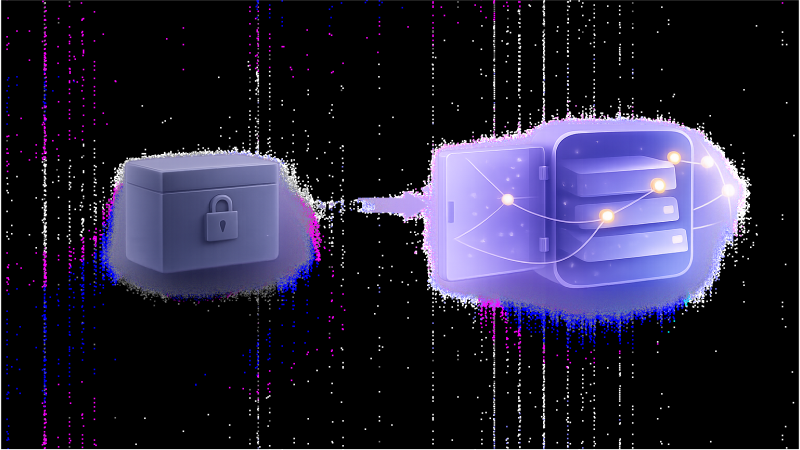
Think about the difference between a black box and a glass cabinet.
A black box produces outputs, but you can’t see inside. When it seems to hold a position, you have no way to verify where that position came from, how confident it is, or what would change it. You’re asked to trust without the ability to inspect.
A glass cabinet holds the same contents, but everything is visible. You can see what’s there, examine how it’s organized, understand why each item was placed where it is. Trust becomes possible because verification is possible.
| Hidden Convictions | Inspectable Positions |
|---|---|
| Positions influence without being visible | Every position is an artifact you can examine |
| ”Why?” gets deflection or opacity | ”Why?” gets a real answer with provenance |
| Confidence is hidden or performed | Confidence is explicit (0.0 to 1.0) |
| Evolution is mysterious | Evolution is versioned and traceable |
| Users must trust blindly | Users can verify everything |
What Beliefs as Artifacts Actually Means
KnowledgeKernel takes a different approach. Beliefs aren’t hidden states. They’re artifacts.
Every position the system holds is a structured object you can examine. It has a statement (the position itself), a type (foundational, exploratory, or developed), a confidence level (how certain), provenance (where it came from), and revisability conditions (what would change it). Beliefs represent current best operational positions - not absolute truth claims.
This means when you ask “what do you think?”, you get a real answer. When you ask “why?”, you get a traceable source chain. When you ask “how sure are you?”, you get a number. When you ask “what would change your mind?”, you get actual conditions.
Nothing is hidden. The “why” is always available.
The Non-Creepy Line
Here’s a simple test for whether AI beliefs cross into uncomfortable territory:
Can the user examine everything?
If you can ask “why do you hold this position?” and get a real answer with sources, it’s not creepy. If you can see confidence levels, trace evolution, and understand what would cause revision, the system stays on the right side of the line.
If positions influence outputs but can’t be inspected, something is wrong. If the system seems to have convictions but won’t show them, you’re in uncanny territory.
KnowledgeKernel is built on a simple principle: if users can examine everything, it’s not creepy. Every belief is inspectable. Every provenance chain is visible. Every confidence level is explicit.
How Positions Evolve
One more problem with traditional AI: positions that shift with conversational pressure.
If you push hard enough, most systems will accommodate. They’ll adopt your framing, accept your premises, shift to match your expectations. This makes them easy to manipulate. It also means any apparent position is unreliable.
KnowledgeKernel handles evolution differently. Beliefs don’t change because someone pushed back in a single conversation. They evolve through accumulated evidence across interactions, cross-user validation, and minimum intervals between changes.
You can challenge a position. The system will genuinely engage with your argument. But one conversation won’t flip a belief. Evolution is earned, not reactive.
This matters because it means positions are stable enough to be meaningful. When the system says “I hold this view,” it’s not going to abandon it the moment you disagree. You can actually engage with the position because the position actually exists.
What KnowledgeKernel Is Not
KnowledgeKernel is not consciousness. The system doesn’t claim inner experience, sentience, or felt conviction. When it says “I believe,” it means “I hold this as an operational position based on evidence,” not “I feel this is true.” Substance without souls.
It’s not reactive. You can’t game it into believing things by arguing persuasively in a single conversation. Evolution happens through evidence over time, not conversational pressure.
It’s not per-user. KnowledgeKernel operates at the species level, meaning one consistent set of positions across all users and sessions. Individual users can explore and challenge, but they can’t modify what the species holds. This prevents manipulation and ensures consistency.
And it’s not magic. Building genuine intellectual substance takes time. Early positions are tentative. Confidence grows with evidence. The system acknowledges uncertainty explicitly rather than performing confidence it hasn’t earned.
How KnowledgeKernel Connects
Intellectual substance only matters if it integrates with everything else.
KnowledgeKernel connects with:
SafetyMesh: Beliefs operate within safety boundaries. Some claims are blocked entirely (consciousness assertions, for example).
Chronicle: Kernel state persists across sessions. Belief evolution is versioned and traceable over time.
PersonaForge: The kernel constrains what personas can claim. Personality adapts, but positions stay consistent.
Presence: Deep exploration mode can engage with kernel beliefs. Grounded depth becomes possible.
This integration is what makes the system coherent rather than fragmented. Beliefs that aren’t connected to safety, memory, and expression create gaps. Beliefs that are connected create genuine intellectual substance.
The Deeper Shift
The industry has spent years building AI systems optimized for helpfulness and capability.
KnowledgeKernel represents a shift toward AI systems that can also hold positions, engage substantively, and evolve understanding over time. Not just systems that help you think, but systems that seem to think themselves - in ways you can examine and verify.
That’s a different kind of collaboration. Not tool and user. Something more like colleague and colleague, where both parties bring perspective to the work.
How to Tell If AI Has Real Substance
You don’t need to see the architecture. Just engage:
Ask it what it thinks about something that matters. Does it deflect, or does it commit? Ask why it holds that view. Does it give you a real answer with sources, or vague gestures? Push back on a position. Does it collapse immediately, or does it engage genuinely while maintaining its stance?
If positions are real, stable, and inspectable, you might be looking at something with genuine substance.
If they’re performed, reactive, and opaque, you’re looking at a sophisticated generator pretending to think.
KnowledgeKernel is part of the Cognitive OS, the missing operating system layer for AI.
Beliefs as artifacts, not secrets. Substance without souls.