
A teacher asks an AI to create a lesson on photosynthesis.
She gets a worksheet. Just the worksheet. No learning objectives. No sequence. No assessment. No scaffolds for struggling students. No extension for advanced learners. No teacher notes explaining the pedagogy.
She asks for an assessment. She gets quiz questions. But they don’t align with the worksheet she already has. Different vocabulary. Different emphasis. Different assumptions about what students learned.
She spends the next two hours assembling pieces, rewriting for consistency, filling gaps, and checking alignment.
The AI saved her fifteen minutes. The integration cost her two hours.
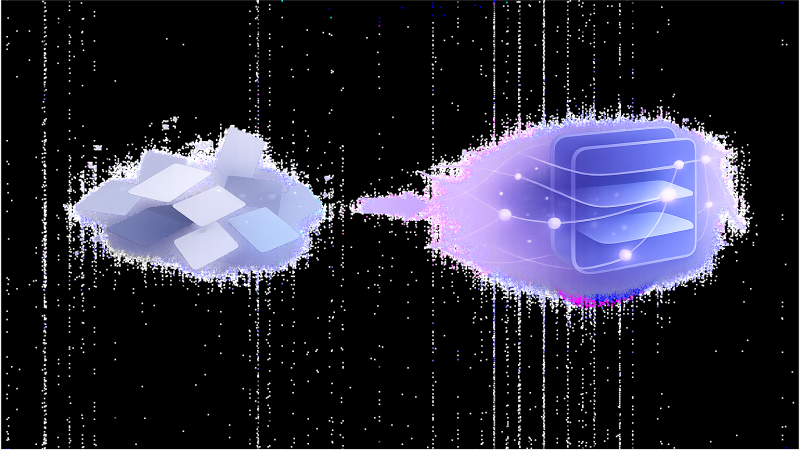
This is what happens when content generation produces fragments instead of bundles.
The Problem With Fragment Generation
Most educational AI treats content creation as a series of independent requests.
Ask for a lesson plan, get a lesson plan. Ask for an assessment, get an assessment. Ask for differentiation, get differentiation. Each output is generated fresh, with no awareness of what came before.
The result is a pile of pieces that don’t fit together. Vocabulary shifts between documents. Learning objectives in the lesson don’t match what the assessment measures. The scaffolds assume different prior knowledge than the main activity. The teacher notes reference activities that don’t exist.
Teachers end up doing integration work that shouldn’t be necessary. They become assemblers of mismatched parts rather than designers of coherent learning experiences.
The problem isn’t that AI can’t generate good content. It’s that generating good pieces doesn’t produce good wholes.
The Contrast: Fragment Generator vs. Curriculum Engine
Think about the difference between a parts supplier and a vehicle manufacturer.
A parts supplier gives you components. An engine here, wheels there, a steering column somewhere else. Each part might be excellent. But assembling them into a working vehicle is your problem. Compatibility is your problem. Integration is your problem.
A vehicle manufacturer delivers something you can drive. The parts work together because they were designed together. The engine fits the chassis. The steering connects to the wheels. Integration happened before delivery, not after.
| Fragment Generator | Curriculum Engine |
|---|---|
| One piece at a time | Complete bundles |
| Each generation independent | All pieces share context |
| Vocabulary drift between pieces | Vocabulary locked across bundle |
| Assessment/lesson misalignment | Assessment tests what lesson taught |
| Answer leakage to students | Blank frameworks enforced |
| Assembly required | Ready to teach |
Most educational AI tools are parts suppliers. The Infinite Content Engine is a vehicle manufacturer.
The Fragment Problem at Scale
Here’s what fragment generation actually costs:
Vocabulary drift: The worksheet uses one set of terms; the assessment uses another. Students get confused. Teachers spend time reconciling terminology.
Alignment gaps: The lesson plan covers concepts the assessment doesn’t test. Or the assessment tests concepts the lesson didn’t cover. Teachers discover this while grading.
Coherence collapse: Materials feel like they came from different teachers - because functionally, they did. Each generation optimized for itself, not for the whole.
Answer leakage: Student materials accidentally contain information that gives away assessment answers. Or answer keys don’t match the questions they’re supposed to answer.
Framework mismatch: Each piece interprets the pedagogical approach slightly differently. The lesson is inquiry-based, but the assessment is recall-focused.
Teachers end up doing what they’ve always done: taking generated fragments and manually forcing them into coherence. The AI accelerated one step while creating work in another.
The same fragmentation problem appears in higher education, corporate training, and certification programs - anywhere learning must be coherent and defensible.
What Complete Actually Means
The Infinite Content Engine generates bundles, not pieces.
When you request a lesson, you receive:
Planning artifacts: Learning outcomes aligned to standards, concept maps showing knowledge structure, lesson sequences with timing, detailed plans with instructional moves, teacher notes explaining pedagogical choices.
Instructional artifacts: Engagement hooks, direct instruction content, guided practice activities, independent practice tasks, discussion questions.
Assessment artifacts: Checks for understanding, formative assessments, summative options, rubrics (both analytic and holistic), exit tickets.
Support artifacts: Differentiation strategies, scaffolds for struggling learners, ELL supports, graphic organizers, sentence frames, tiered tasks for different readiness levels.
Extension artifacts: Enrichment activities, cross-curricular connections, homework options, family communication templates.
All of this, coherent. All of this, aligned. All of this, generated together rather than assembled after.
Blank Framework Enforcement
One specific problem deserves attention: answer leakage.
When AI generates educational content piece by piece, it doesn’t maintain separation between what teachers should know and what students should discover. Worksheets accidentally embed answers in the questions. Scaffolds provide so much structure that thinking becomes unnecessary. Assessment items telegraph correct responses through their construction.
The Infinite Content Engine enforces blank frameworks. Student materials have answer spaces, not answers. Discovery is protected. Assessment validity is maintained.
This matters because integrity failures in educational content undermine the entire purpose of assessment. If students can reverse-engineer answers from the materials, you’re not measuring learning. You’re measuring puzzle-solving.
Framework Alignment Without Rigidity
Different schools use different pedagogical frameworks. UbD (Understanding by Design), UDL (Universal Design for Learning), Bloom’s Taxonomy, Webb’s Depth of Knowledge, inquiry-based approaches, project-based learning, Montessori methods, IB frameworks, state standards.
Most content generators ignore this. They produce generic output that doesn’t fit how your school actually teaches.
The Infinite Content Engine adapts. The same underlying content can be restructured for any framework. Generate a lesson, then apply UbD structure and watch it reorganize into Stage 1 (desired results), Stage 2 (evidence), and Stage 3 (learning plan). Switch to inquiry-based framing and the same content reorganizes around driving questions and investigation cycles.
The pedagogy is honored, not ignored.
A Concrete Scenario
A 7th-grade science teacher needs to teach cellular respiration tomorrow. She has 45 minutes tonight to prepare.
Without ICE:
She prompts an AI for a lesson plan. Then a worksheet. Then an assessment. Then an answer key. Each generation takes a few minutes, but the pieces don’t quite align. The worksheet emphasizes glucose breakdown; the assessment emphasizes ATP production. The vocabulary differs slightly. She spends an hour editing for coherence. Total time: 90 minutes. Improvement over from-scratch: marginal.
With ICE:
She requests a complete cellular respiration bundle for 7th grade, 50-minute class period, aligned to NGSS standards, inquiry-based approach.
She receives: Lesson plan with timing, materials, and facilitation notes. Student worksheet with blank spaces for discovery. Exit ticket assessment aligned to the lesson objectives. Answer key matching the worksheet and assessment exactly. Differentiated versions for advanced learners and students needing support.
All pieces use consistent vocabulary. Assessment tests what the lesson taught. Answer key matches the questions. Differentiated versions maintain coherence with the core.
She reviews, makes minor adjustments, done. Total time: 20 minutes.
That’s the difference between generating fragments and receiving curriculum.
What the Infinite Content Engine Is Not
It’s not a curriculum generator. It creates instructional materials, not year-long scope and sequence documents or district pacing guides.
It’s not a grading engine. It creates assessments and rubrics, but it doesn’t score student work.
It’s not student-facing. This is a tool for educators. Student-facing tutoring uses different architecture optimized for different goals.
It’s not a replacement for teacher judgment. The system augments expertise. It handles the production work so teachers can focus on the design decisions that actually require professional knowledge.
And it doesn’t copy. The system generates original content. It can’t reproduce copyrighted textbooks, proprietary assessment items, or licensed materials. What it creates is new, even when aligned to existing standards and frameworks.
How the Infinite Content Engine Connects
Content generation only works if it’s governed and integrated.
The Infinite Content Engine connects with:
SafetyMesh: Content generated within safety boundaries. Age-appropriate, culturally sensitive, pedagogically sound.
Chronicle: Long-form content continuity. Complex units maintain coherence across multiple sessions.
AuditLens: Every pedagogical decision traceable. Why was this scaffold included? Why does this assessment measure that objective? The reasoning is available.
ORCHESTRA: Internal specialist team coordination. Multiple perspectives (curriculum design, assessment, differentiation, engagement) negotiate to produce unified output.
This integration is what makes the output trustworthy rather than just fast.
How to Tell If Content Generation Is Real
You don’t need to see the architecture. Just test:
Ask for a lesson. Then ask for the assessment. Do they align, or do they feel like separate generations? Ask for differentiation. Does it use the same vocabulary and objectives, or does it drift? Check student materials. Are answers absent, or do hints leak through?
If pieces fit together without assembly work, you might be looking at a curriculum engine.
If you’re doing integration yourself, you’re using a fragment generator.
The Infinite Content Engine is part of the Cognitive OS, the missing operating system layer for AI.
Complete bundles, not fragments. Ready to teach, not ready to assemble.