
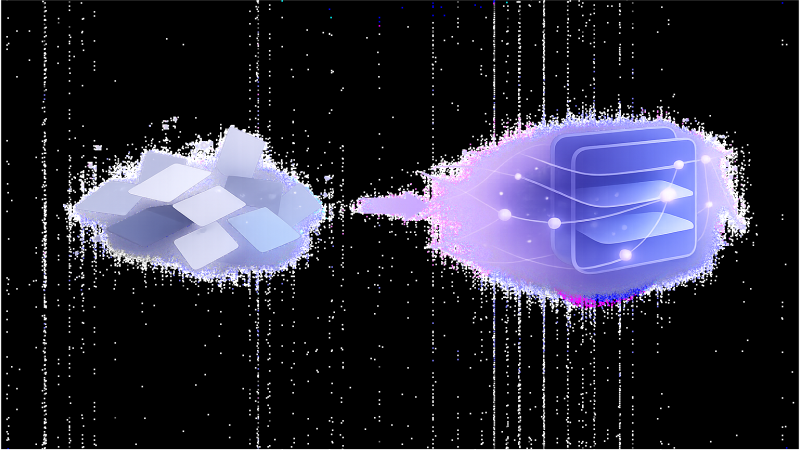
Coherent Content Systems, Not Fragment Generation
Most AI generates pieces. The Infinite Content Engine generates systems.
The Infinite Content Engine is a domain-agnostic system for generating multi-part content sets that remain structurally aligned, constraint-consistent, and internally coherent - regardless of domain.
In education, this manifests as lesson bundles. In training, as onboarding sequences. In documentation, as aligned reference sets. The capability is the same: architectural coherence across multiple related artifacts.
This is not a content generator. It’s a coherence engine.
“Infinite” refers not to volume, but to the engine’s ability to extend coherent generation across arbitrarily many domains and artifact types without degrading alignment.
The Problem the Infinite Content Engine Solves
You’ve seen this pattern across domains.
You need multiple related pieces of content. You generate them one at a time. Each piece optimizes for itself, not for the whole.
The result:
Vocabulary drift - Piece A uses one set of terms; Piece B uses another. Users notice the inconsistency.
Alignment gaps - The overview covers concepts the details don’t support. The assessment tests things the training didn’t teach.
Constraint violations - Rules that should apply everywhere get applied inconsistently. Exceptions appear where they shouldn’t.
Coherence collapse - The pieces feel like they came from different authors - because functionally, they did.
Manual assembly tax - Someone has to take the fragments and force them into coherence. The AI accelerated one step while creating work in another.
This isn’t a content quality problem. It’s an architectural problem. Fragment-based generation can’t produce system-level coherence because each fragment is generated in isolation.
The Contrast
| Without Infinite Content Engine | With Infinite Content Engine |
|---|---|
| Fragment generation | Bundle atomicity |
| Vocabulary drift across artifacts | Vocabulary locking |
| Alignment gaps between pieces | Objective traceability |
| Constraint violations between outputs | Constraint propagation |
| Manual assembly required | Coherent systems by architecture |
| Content Generator | Coherence Engine |
| Pieces that need assembly | Systems that cohere |
Architectural Invariants
The Infinite Content Engine enforces guarantees that fragment-based generation cannot provide:
Bundle Atomicity
Content is generated as a unit, not assembled from fragments. All pieces are created with awareness of all other pieces. This isn’t post-hoc alignment - it’s generative coherence.
Vocabulary Locking
Terms are consistent across all artifacts in a bundle. When a concept is named, that name propagates. No drift, no inconsistency, no “wait, is that the same thing?”
Objective Traceability
Every output artifact maps to specified objectives. Assessments test what content covers. Details support what overviews promise. Nothing orphaned, nothing unsupported.
Constraint Propagation
Changes cascade across all artifacts. Modify a constraint, and everything that depends on it updates. No manual propagation, no missed updates, no inconsistency windows.
Separation Enforcement
When artifacts should be separated (discovery vs. answers, public vs. internal, summary vs. detail), that separation is architectural. No leakage, no accidental exposure, no boundary violations.
Governed Synthesis
All outputs pass through SafetyMesh and AuditLens. Coherence doesn’t bypass governance. Every artifact in every bundle meets the same safety and transparency standards.
How It Works
Domain-Agnostic Architecture
The Infinite Content Engine doesn’t know about lesson plans or training modules or documentation sets. It knows about:
- Artifact types - distinct content pieces with defined relationships
- Alignment constraints - rules about how artifacts must relate
- Vocabulary scopes - term consistency requirements
- Separation boundaries - what must stay distinct from what
- Propagation rules - how changes flow through the system
Domains configure these parameters. The engine enforces them.
Coordinated Generation
The engine coordinates specialist roles within the orchestration graph (via ORCHESTRA) to produce unified output:
- Structure roles ensure architectural integrity
- Content roles generate domain-accurate material
- Constraint roles verify alignment rules
- Coherence roles confirm cross-artifact consistency
Users see unified bundles. The coordination is invisible - but it’s why the bundles cohere.
Progressive Revelation
Complete bundles are always generated internally. What’s shown can be controlled - piece by piece, all at once, or selectively. The coherence exists whether or not all pieces are visible.
Domain Examples
The same architectural capability manifests differently across domains:
Education Example: Instructional Bundles
A curriculum system needs lesson plans, student materials, assessments, and answer keys - all aligned to the same objectives, using consistent vocabulary, with answers separated from discovery materials.
The Infinite Content Engine generates these as a coherent bundle: assessment tests what the lesson teaches, vocabulary is consistent throughout, student materials never leak answers.
Training Example: Onboarding Sequences
An enterprise needs orientation materials, role-specific guides, knowledge checks, and reference documentation - all aligned to competency frameworks with consistent terminology.
The Infinite Content Engine generates these as a coherent bundle: checks verify what materials cover, terminology is locked across all pieces, role-specific content aligns with general orientation.
Documentation Example: Reference Systems
A platform needs API documentation, tutorials, quick-start guides, and troubleshooting references - all describing the same system consistently.
The Infinite Content Engine generates these as a coherent bundle: tutorials reference APIs accurately, troubleshooting aligns with documented behavior, terminology is consistent throughout.
How It Connects
Infinite Content Engine + SafetyMesh
All generated content passes through safety governance. Domain-appropriate constraints apply - educational content gets age-appropriate handling, training content gets compliance-appropriate handling. Coherence never bypasses safety.
Infinite Content Engine + Chronicle
Generation builds on prior context. What’s been generated before, what objectives have been covered, what vocabulary has been established - Chronicle tracks this so subsequent bundles maintain continuity.
Infinite Content Engine + ProfileForge
Different operators have different patterns. ProfileForge notices preferences and adapts generation accordingly - while maintaining architectural constraints.
Infinite Content Engine + AuditLens
Generated content should be inspectable. AuditLens exposes how alignment was achieved, what constraints were applied, and why specific approaches were chosen.
Infinite Content Engine + ORCHESTRA
Bundle coherence requires coordination. ORCHESTRA manages the specialist perspectives that contribute to unified generation.
What the Infinite Content Engine Is Not
The Infinite Content Engine is not:
- A user-facing tool - it’s infrastructure; species like educational assistants are built on top of it
- Domain-specific - it’s domain-agnostic; domains configure it, they don’t define it
- A content library - it generates fresh coherent bundles, not retrieves pre-made content
- A replacement for domain expertise - it enforces coherence; domain knowledge comes from configuration and specialist integration
- Magic - generated content still benefits from review; architectural coherence doesn’t guarantee domain perfection
When the Infinite Content Engine Matters Most
The Infinite Content Engine is essential when:
- Multiple related artifacts must cohere - not just individually good pieces, but aligned systems
- Vocabulary consistency matters - terms must mean the same thing everywhere
- Constraints must propagate - changes in one place must flow to dependent pieces
- Separation must hold - boundaries between artifact types can’t leak
- Scale amplifies incoherence - manual assembly becomes unsustainable
The Question You Should Ask
Here’s how to evaluate whether a system produces coherent content:
Don’t ask how fast it generates individual pieces. Speed on fragments doesn’t matter if you spend the time saved on assembly.
Instead, request multiple related pieces. Check vocabulary consistency across all of them. Verify that constraints applied to one apply appropriately to others. Confirm that separation boundaries hold. Modify something and see if dependent pieces update.
If you get fragments that require manual coherence work, you’re looking at a content generator.
If you get systems where everything aligns by architecture, you might be looking at something different.
What to Do Next
→ See It Working with a multi-artifact request
→ Check cross-artifact alignment - vocabulary, objectives, constraints
→ Test constraint propagation - modify something and see what updates
Then ask yourself: “Did I get pieces that need assembly? Or a system that coheres?”
That’s the Infinite Content Engine.
| Without Infinite Content Engine | With Infinite Content Engine |
|---|---|
| Fragment generation, vocabulary drift across artifacts, alignment gaps between pieces, constraint violations between outputs, manual assembly required | Bundle atomicity, vocabulary locking across all artifacts, objective traceability, constraint propagation, coherent systems by architecture |