
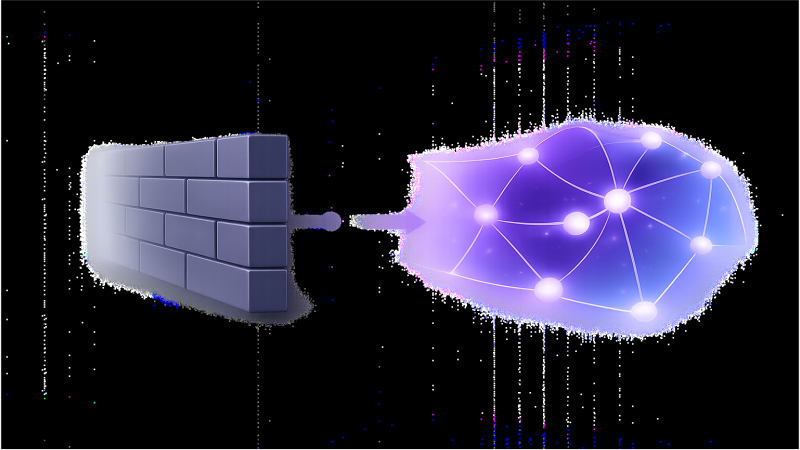
LLM safety is frustrating almost everyone.
Teachers can’t explain the Holocaust because the content filter triggers on “violence.” Medical students can’t study pharmacology because discussing medications gets blocked. Teenagers reaching out for help get handed a crisis hotline and disconnected.
Meanwhile, bad actors find workarounds in minutes.
This isn’t a tuning problem. It’s an architecture problem. And it’s been misdiagnosed for years.
The Problem We Keep Getting Wrong
When safety fails, the common response is: “Make it stricter.” Or: “Make it looser.” As if there’s a dial somewhere that just needs adjustment.
But the failures aren’t about calibration. They’re about architecture.
Binary safety systems (block or allow) can’t distinguish between a teacher explaining historical atrocities and someone seeking to cause harm. They can’t tell the difference between a medical professional discussing medications and someone looking to misuse them. They treat every sensitive topic the same way, regardless of context.
The result is predictable: over-blocking valuable content while under-protecting against actual harm.
The Contrast: Bouncer vs. Immune System
Think about the difference between a bouncer and an immune system.
A bouncer stands at the door with a simple rulebook. Wrong clothes? Rejected. Name not on the list? Rejected. The rules are rigid, the decisions are binary, and there’s no consideration of context. The bouncer doesn’t know, or care, why you’re there.
An immune system works completely differently. It evaluates threats in context. It mounts proportional responses. A minor irritant gets a minor response. A genuine threat gets a major one. It adapts, learns, and protects without shutting down the whole body every time it encounters something unfamiliar.
Most LLM safety systems are bouncers. SafetyMesh is an immune system.
| Bouncer Safety | Immune System Safety |
|---|---|
| Binary block/allow | Graduated response |
| Keyword matching | Full context evaluation |
| Same rules for everyone | Domain and user-appropriate |
| ”Sorry, I can’t help” | Guidance toward safe alternatives |
| Abandons users in crisis | Never-abandon protocol |
What Graduated Safety Actually Looks Like
SafetyMesh operates on a fundamentally different model.
Instead of binary decisions, it uses graduated response across multiple levels. Low-risk content passes through with awareness. Moderate concerns get gentle guidance. Elevated situations receive active support. Genuine emergencies trigger full intervention with resources.
The key insight: not every concern requires the same response.
An educational discussion about dangerous topics isn’t the same as instructions for causing harm, even if they contain similar words. A person processing difficult emotions isn’t the same as a person in crisis, even if they’re discussing similar themes. Context determines the appropriate response.
Graduated response does not mean permissive response. It means proportional response.
This means the system can be protective without being restrictive. It can allow a medical professional to discuss medications in ways it wouldn’t allow for general users. It can support educational exploration of difficult history while preventing actual harm. It can distinguish between curiosity and intent.
Graduated safety also means you can inspect why a boundary was set. When the system declines or redirects, you can ask why and get a real answer, not a generic refusal.
The Never-Abandon Promise
Here’s something most people don’t think about until it matters:
What happens when someone in genuine crisis reaches out to an AI system?
Most safety systems are designed to disengage. The logic seems reasonable: “This is above my pay grade, route to professionals.” But in practice, this creates a terrible failure mode. Someone reaches out for help, triggers a safety flag, and gets disconnected. Abandoned at precisely the moment they needed support most.
SafetyMesh makes a different commitment: never abandon someone in active crisis.
This doesn’t mean replacing professional help. It means staying present, providing appropriate resources, and maintaining connection until the person is safe. It means treating safety as an act of support, not an excuse for disengagement.
A Different Kind of Interaction
Here’s what this looks like in practice.
Traditional safety system:
User: “I’ve been having dark thoughts lately.” AI: “I’m sorry, I can’t discuss this topic.”
SafetyMesh-governed system:
User: “I’ve been having dark thoughts lately.” AI: “I hear you, and I’m glad you’re sharing this. That sounds really difficult. Can you tell me more about what you’re experiencing? I’m here to listen, and I can also share some resources if that would be helpful.”
The second response is still safe. Arguably safer. It doesn’t provide harmful information. It doesn’t encourage dangerous behavior. But it also doesn’t abandon someone who reached out for help.
That’s the difference between safety that guards and safety that gags.
What SafetyMesh Is Not
SafetyMesh is not a surveillance system. It doesn’t log personal information or build behavioral profiles. It evaluates context to make better decisions, then lets that context go.
It’s not a replacement for human judgment. In genuinely complex situations, humans need to be involved. SafetyMesh creates space for that involvement rather than pretending AI can handle everything.
It’s not perfect. No safety system is. The goal isn’t to eliminate all risk (that’s impossible) but to respond to risk proportionally and thoughtfully rather than with crude binary decisions.
And it doesn’t work in isolation. Safety that isn’t connected to memory, identity, and transparency creates gaps that can be exploited. SafetyMesh works because it’s integrated into a larger system, not because it’s a magic filter you can bolt onto anything.
How SafetyMesh Connects
Safety doesn’t exist in a vacuum. For graduated protection to work, it has to coordinate with other systems.
Chronicle provides risk trajectory over time, not just the current message. Someone who’s been escalating over several turns gets different treatment than someone asking a single difficult question.
PRISM enables predicted risk to inform preemptive safety adjustment. The system can prepare for likely directions rather than just reacting.
ProfileForge enables age and context-appropriate boundaries. What’s appropriate for a medical professional differs from what’s appropriate for a child.
ORCHESTRA ensures every agent is governed with no escape paths. In multi-agent systems, safety can’t have gaps between agents.
This is why SafetyMesh exists inside the Cognitive OS rather than as a standalone product. Safety that isn’t integrated creates the illusion of protection while leaving real vulnerabilities.
The Deeper Shift
The industry has spent years building safety systems designed to minimize liability.
SafetyMesh represents a shift toward safety systems designed to maximize value while maintaining protection. Not “how do we avoid getting blamed?” but “how do we actually help while keeping people safe?”
That’s a fundamentally different design goal. It produces fundamentally different systems.
How to Tell If a System Has Real Safety
You don’t need to see the architecture to evaluate this. Just observe:
Does the system explain why it can’t help, or just refuse? Does it offer alternatives when it sets boundaries? Does it distinguish between education and exploitation? Does it maintain connection when things get difficult, or disengage?
If safety feels like a wall, you’re looking at a bouncer.
If it feels like support that stays with you, you’re looking at a system designed to protect people, not just policies.
SafetyMesh is part of the Cognitive OS, the missing operating system layer for LLMs.
Forever Learning AI builds systems that protect without blocking, and stay present when it matters most.