
You’ve felt this before.
An AI system adapts to you in ways that feel… off. It knows things you don’t remember telling it. It adjusts in ways you can’t explain. When it works, it feels unsettling. When it fails, it feels incompetent. When you try to find out what it knows about you, you can’t.
This is what happens when personalization is built on surveillance instead of attention.
The Problem With Personalization Today
Modern AI personalization follows a familiar playbook: collect everything, store it forever, use it however you want, and never let users see what you’ve gathered.
The result is a system that might work well but feels wrong. Users sense they’re being watched without understanding how. They benefit from adaptation but don’t trust it. And when they ask “what do you know about me?”, they either get nothing or a data dump that raises more questions than it answers.
This isn’t a small problem. It’s the reason personalization has a reputation problem.
People want AI that understands them. They don’t want AI that watches them.
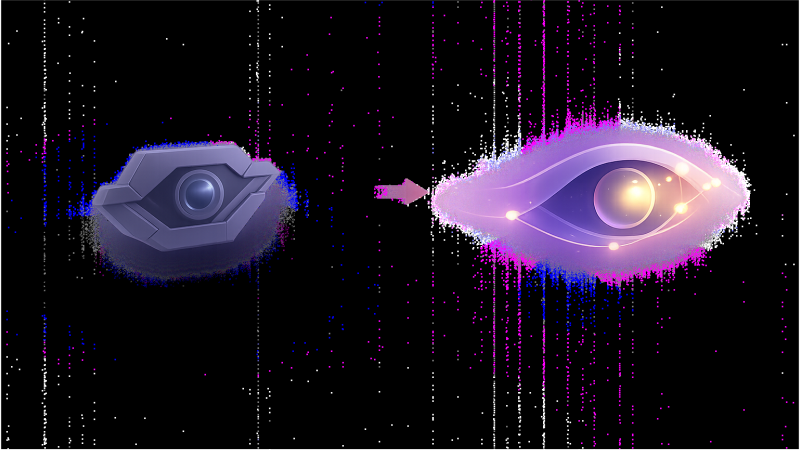
The Difference Between Surveillance and Attention
Think about the difference between being watched and being understood.
A spy watches you silently. They build hidden files. They never explain themselves. If you ask what they know, they deflect or disappear. The relationship is fundamentally adversarial, even if they claim to be helping you.
A good colleague pays attention. They notice patterns in how you work. They remember your preferences. But they’re also transparent about what they’ve observed, open to correction, and clear about why they’re paying attention in the first place.
Surveillance collects data. Attention notices patterns.
Surveillance stores everything. Attention infers and summarizes - not raw interaction logs retained indefinitely.
Surveillance hides what it knows. Attention shows you - and lets you change it.
| Surveillance | Attention |
|---|---|
| Data collected and stored | Patterns inferred and summarized |
| Hidden profiles | Full transparency |
| No user control | Edit, delete, export anything |
| Feels creepy when it works | Feels like a good colleague |
| Sold to third parties | Never leaves the conversation |
The Non-Creepy Line
Here’s a simple test for whether personalization crosses the line:
Can users see everything the system knows about them?
If yes, it’s not creepy. It might be sophisticated, it might notice things users hadn’t articulated, but if everything is visible and editable, the relationship stays healthy.
If no, something is wrong. Hidden profiles create hidden power imbalances. Users can’t trust what they can’t inspect.
ProfileForge is built on this principle. Everything it infers is visible. Everything visible is editable. Everything editable is deletable.
What ProfileForge Actually Does
ProfileForge notices patterns in how you work - and adapts accordingly.
It observes:
- Communication preferences - how you like information delivered
- Working style - how you approach problems, make decisions, iterate
- Expertise signals - what you know well, where you need support
- Interaction patterns - when you want depth vs. brevity, examples vs. abstractions
It learns through:
- Demonstrated behavior - what you actually do, not what you claim
- Explicit feedback - corrections and preferences you state directly
- Accumulated patterns - consistency across interactions over time
It maintains:
- Full visibility - you can see everything it has inferred
- Complete editability - you can correct any inference
- Total deletability - you can remove anything, including everything
- Transparent reasoning - you can see why it inferred what it did
The principle is simple: The user owns their profile. Completely.
The False Tradeoff
Most AI oscillates between creepy and useless. Either it knows too much and you don’t trust it, or it knows nothing and you have to manage it constantly.
The problem is that personalization has been framed as a tradeoff: helpfulness vs. privacy. More personalization means more data collection. More privacy means less adaptation.
This framing is wrong.
Personalization doesn’t require surveillance. It requires attention - noticing what matters, adapting accordingly, and being transparent about the whole process.
ProfileForge proves that you can have sophisticated personalization with complete user control. The tradeoff was never real. It was just the easiest way to build.
What ProfileForge Is Not
ProfileForge is not a data warehouse. It doesn’t accumulate unbounded files on users.
It’s not cross-context tracking. It doesn’t follow you across the internet or combine data from external sources.
It’s not hidden profiling. Everything it knows is visible to you.
It’s not inference without limits. Protected categories - medical, political, religious, financial - are never inferred. Not “we promise not to.” We architecturally cannot.
It’s not cross-user modeling. Inferences are never shared or generalized across users.
How ProfileForge Connects
Personalization doesn’t exist in isolation. For transparent user understanding to work, it has to coordinate with other systems.
PRISM uses ProfileForge to calibrate predictions to individual patterns - recognizing what “low engagement” means for this specific user, not users in general.
Chronicle uses ProfileForge to make memory prioritization user-aware. Significance weighting becomes personalized over time.
PersonaForge uses ProfileForge to let personas adapt to user characteristics. A tutor persona adjusts its depth based on demonstrated expertise.
SafetyMesh uses ProfileForge for age and context-appropriate boundaries. What’s appropriate differs by user context.
This is why ProfileForge exists inside the Cognitive OS rather than as a standalone product. Personalization that isn’t integrated creates the illusion of understanding while leaving real gaps.
The Deeper Shift
The industry has spent years building personalization designed to maximize engagement - for the company’s benefit.
ProfileForge represents a shift toward personalization designed to maximize user benefit with full transparency. Not “how do we get users to do what we want?” but “how do we help users accomplish what they want?”
That’s a fundamentally different design goal. It produces fundamentally different relationships.
How to Tell If Personalization Is Trustworthy
You don’t need to see the architecture. Just ask:
Can you see what the system knows about you? Can you correct it when it’s wrong? Can you delete it if you want? Does it feel like being understood, or being watched?
If personalization feels like surveillance, something is broken.
If it feels like attention from a colleague who’s genuinely trying to help, you might be looking at something worth trusting.
ProfileForge is part of the Cognitive OS, the missing operating system layer for AI.
Forever Learning AI builds AI that understands without watching - and puts users in complete control.