There are two kinds of fun.
One asks nothing of you. It scrolls, it plays the next episode, it agrees with whatever you type. It is easy to start and easy to stop, and an hour later it is hard to say what happened.
The other kind asks something. Read this carefully. Notice that detail. Try an idea, watch it fail, and try a better one. It is slower to start, and it is the kind people talk about years later, because the moment they keep is one they made themselves: the moment they worked it out.
Adventures is built for the second kind.
The first games were made of words
Many of the first computer games people played had no pictures at all. Colossal Cave Adventure, and later Zork, put a paragraph on the screen and waited for you to type. You read where you were. You typed what you wanted to do. The game answered, and you read again.
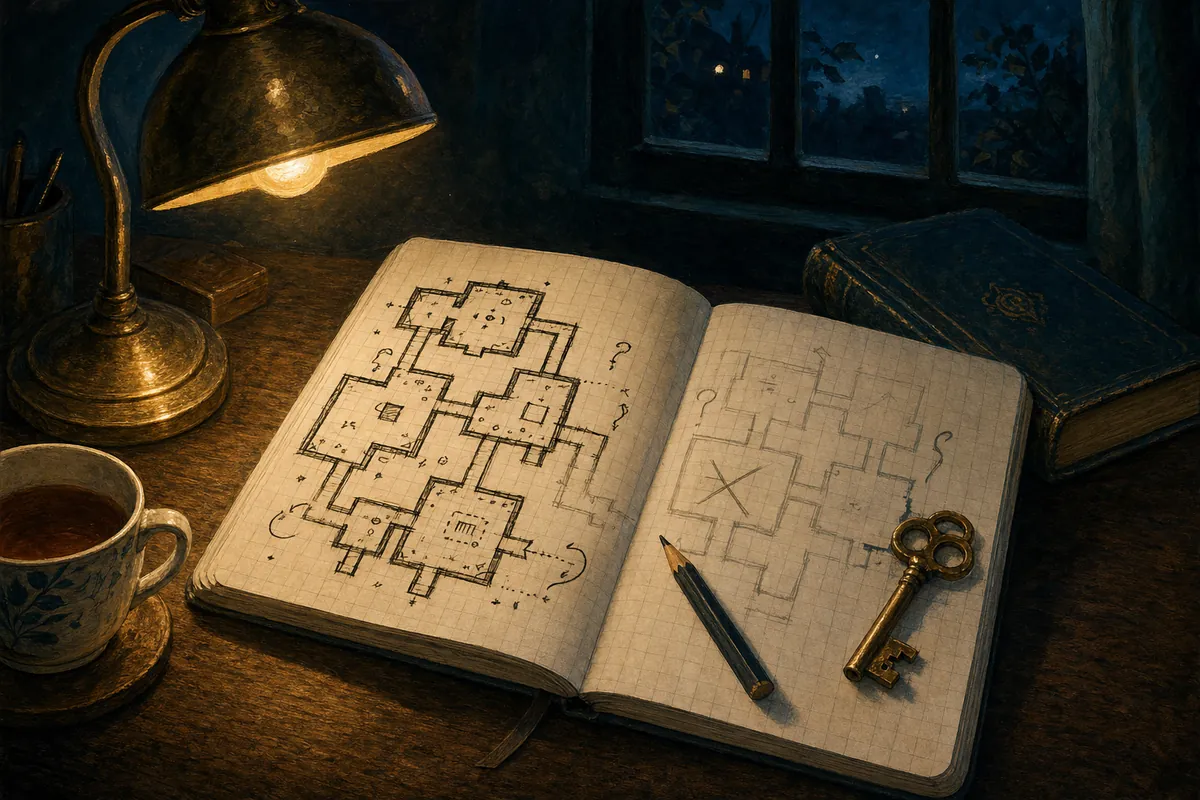
Those games were hard in a particular way. A door would not open, and nothing on the screen told you why. So players read every description twice, drew maps by hand, kept notes, and argued with friends about what a line of text really meant. When the door finally opened, it opened because someone had thought their way to it.
That is the feeling we wanted back. Not the parser, which made you guess the one phrasing the game understood, and not the boxes of the 1980s. The thinking.
Reading is how you play
In a game made of words, reading is the controller. A description is not decoration. The cracked tile, the clerk who looks away when you mention the archive, the clock that is four minutes fast: any of them might be the way forward, so you read the way a detective reads, slowly and on purpose.
Adventures keeps that and removes the old frustration. You act in your own words, in a full sentence, the way you would describe it to a friend. The storyteller answers that action, in the voice of the world, with a paragraph written for what you just did. And because the world underneath is fixed, the detail you noticed ten minutes ago is still true when you come back to use it. What you change stays changed.
The result is reading with stakes. Not reading as homework, and not reading as wallpaper. Reading because the next paragraph is about you.
A puzzle is a question the game trusts you to answer
A good puzzle is fair. Everything you need is somewhere in the world, and the game will not hand it to you. You notice something, form a theory, test it in your own words, and either you are right or you learn something about why you are wrong.
That last part matters more than it sounds. A story that says yes to everything cannot have puzzles, because there is nothing to be wrong about. We learned this the hard way: left to invent the story as it went, the model opened every door and made every idea work, and nothing it produced was worth solving. In Adventures the puzzles are designed before you arrive, by people, with answers. You can be wrong. That is what makes being right feel like something.
The Library of Last Resort, the first adventure open, starts with an errand. You have come to return one overdue Book. The Book has been promoted, its staff badge outranks you, the Returns Desk insists it is not here, and the closing bell is gathering overhead. None of that is solved by asking the narrator to make it go away. It is solved the way the old games were solved: by paying attention to how this place works and using it.
An ending is a promise
Every adventure has an ending, written by its author before anyone played. That is a design choice, and it shapes everything before it.
An ending means the story is going somewhere. The clues are clues because they lead to it. Your choices count because they change how you arrive. And when you get there, you are finished, in the good sense: the way you finish a mystery novel or a hard crossword, with the whole shape of it suddenly clear. A story that never ends cannot give you that. It can only stop.
That is why the line on the product page reads the way it does. Play. Solve. Finish.
Why this kind of play matters
We are not against easy fun. Everyone needs the evening that asks nothing.
But there is another kind of evening that leaves you sharper than it found you, and it has always had a shelf of its own: the mystery novel, the crossword, the escape room, the board game that ends in an argument about the rules. People choose those because the thinking is the pleasure. They are not studying. They are playing, hard.
Adventures belongs on that shelf. And the shelf is wide. A comedy asks you to read people and timing. A social deduction game asks you to keep a borrowed story straight while someone across the table tests it. A historical investigation asks you to weigh evidence before a deadline. A corridor of mirrored doors asks you to commit to a choice and then shows you the principle you used. Each kind of story asks for a different kind of attention, and that variety is the point of building a platform rather than a single game.
What this does not claim
It does not claim that Adventures teaches reading, improves grades, or makes anyone smarter. It is entertainment. When we make titles meant to teach, we will say what they teach and how we know.
It does not claim that words beat pictures. Every adventure is illustrated, and the art is part of the world.
It does not claim that easy fun is bad, or that every game should be a puzzle.
It claims that games can make you think, that the thinking is the fun, and that Adventures is built for exactly that. The Library of Last Resort is open now, free to start.