
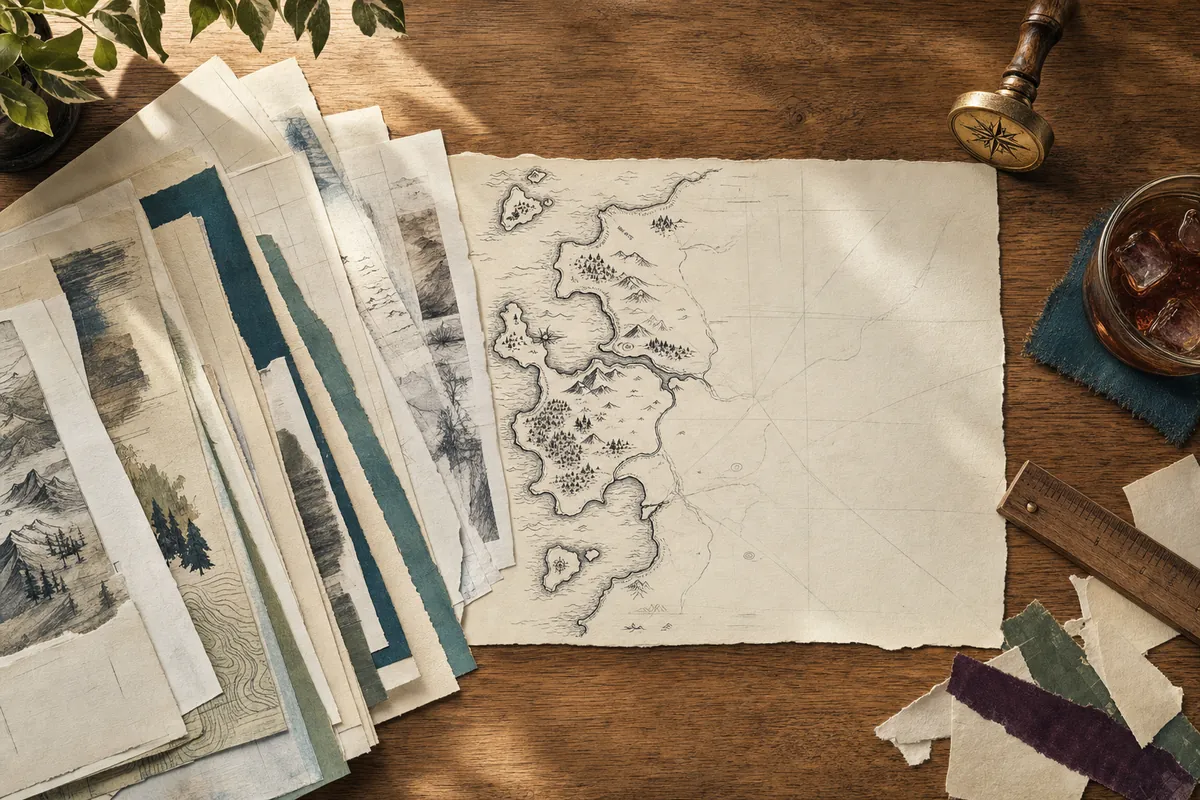
We have written before about why an AI storyteller still needs a writer. This is the next question people ask: what does the writing actually look like? Here is how an Adventure goes from an idea to a world a stranger can play, told through the one we are writing now.
It starts as sixteen documents
The adventure in development began with a feeling and a girl. A seventeen-year-old on the morning of the day her town decides what she is for, going out for the mail. Before a line of the playable world existed, that idea became a set of sixteen working documents: the world and its rules, the arc from the first page to the last, who is telling it, what it is about, a roster and a sheet for every person who matters, a map and a sheet for every place in each of its states, every puzzle with its answer and its cost, the side stories, the history, the clock, a bible for the art, and a register of every decision.
That set is not a manuscript. Almost none of it is prose a player will read. It is the sum of what someone decided: what is true, what is hidden, what it takes to find out, and what it costs. The storyteller writes the sentences later, fresh, for each player. The decisions are what it performs.
The voice is built by anatomy
An Adventure’s storyteller has a voice players will meet by name. We build it by taking two or three authors whose work has the thing we want and taking them apart in seven craft dimensions: how a scene is built, how information arrives, the sentence, time, what is trusted to the reader, framing, and how a page ends. For each, we write what that voice does, what ours keeps and what ours leaves. Then we write the result as one person, in abstract craft terms. No author’s name ever enters the storyteller.
The result is a set of starting settings, held as short fields and tuned in playtesting by editing a field and rerunning the same scene. For this adventure three of those settings were turned softer after a side-by-side read of the same scene two ways. The starting voice is a warm proceduralist with a short sentence, who loves the people filed in a system and lets the record speak. Nothing about a voice is final until long into playtesting.
The storyteller is told nothing it has not earned
The storyteller’s persona contains no story. Not the plot, not the people, not the places, not the rules of this world, and not a list of things to avoid mentioning yet. The first draft of this adventure’s persona described the book, and review withdrew it on a rule we had already learned to trust: a performer told “here is the ending, do not mention it” cannot un-know it, and in our experience that instruction fails beyond very small exceptions.
So the story reaches the storyteller turn by turn, as it is needed and only once it has been earned. Each turn the game hands it where the player is and what is true there now, who is in the room, what the player carries and can do, and what just happened. A secret is written once, with the deed that earns it, and arrives only after that deed.
The author’s relationship to each character has to live somewhere, so it lives with the character. Every person has a card the storyteller receives only while they are present: who they are to the player, what they want right now, how they talk, and the author’s eye on them, meaning what the author loves and protects in this person, what is funny about them and what never is. When the persona stopped carrying the book, this is where the book’s warmth went.
Every fact has a lifetime
Turning the set into a playable world means writing, for the first two chapters, a few hundred small pieces of text: statements of what is true of a place or a thing under a condition; cards for people; texts for what each action changes and what is true when it cannot be done; events on the clock; and the journal entries, place summaries and labels a player reads with no storyteller between. All of them are tied to the same names, so the game, the storyteller and the illustrator mean the same thing.
Then independent AI reviewers read it, each with one lens: leaks and spoilers; conditions and contradictions; the narrator’s eye and register. They found no withheld fact in the persona, the character cards or the first chapter. They found the mechanical defects a first draft always has: statements with no lifetime, so they would follow the player everywhere for the rest of the game; facts with two owners, which contradict each other; and, in the second chapter, the answer to a puzzle sitting in the storyteller’s hands with a friend in the room who could say it. A script now walks every statement against the ledger and assembles what the storyteller would be handed on a set of stated turns. An early cut had a hundred and thirty-seven open items. Two cuts later there were none.
A picture is as much canon as a sentence
The art is planned the same way: every picture keyed to the state that shows it, each place in each of its states, each person, each thing, the map as a drawing that grows as the player walks it. The reviewer for the art list found a defect none of the others could have. A portrait brief had given the illustrator a detail the story had not yet earned, a tell the written statements deliberately kept out. Drawn, it would have told the reader before the words could.
The rule that came out of it is simple to state and strict to keep: words, pictures and the record agree on the same turn, every turn. Where the words say a plate has become legible, the picture of that room shows it legible and the journal shows the same words. Where two objects stand in a room, the picture shows two.
Playtesting is where it becomes final
Play, trace, change one thing, replay. The author judges richness, relevance, character engagement, the accuracy of what the storyteller reported, and the outcome, each separately, and tunes one thing at a time. A chapter is accepted when it has been played end to end and the author has read what players actually received.
Where AI helped, and where people decided
We use every tool we have to write, including AI, the way any working writer now does. Drafting assistants wrote first cuts of the supporting character sheets, the location sheets and the art bible under direction, and each has been read against the decisions and is still under review. AI reviewers read every draft, each with one lens. A person read every draft, ruled every open decision, and accepted the result. The storyteller itself, which performs the finished work, is AI.
Every decision that makes the story a story was a person’s: the premise, the people and their wants, what is withheld and what earns it, the puzzle and its cost, the ending, the voice, and every one of the hundred-odd rulings in the register, walked one at a time. That division is the only way we have found to make a world that holds.
What this does not claim
It does not claim the adventure is finished or available. It is in development, and this is an account of its method, not a release.
It does not claim that this is the only way to write for an AI storyteller. It is the way that worked on our first adventure and is carrying the second, and it is written down so that authors we work with can use it.
It does not claim that AI contributed nothing to the writing. It drafted, it reviewed, and it performs. A person decided.