
Forty minutes into a first date, the easy questions have run out. The quiet lasts a little longer than you expected. You start deciding what it means before either person has said anything. Then the other person asks what you could talk about for ten minutes without preparing.
That is the opening in this Conversations demonstration. You can enter the same situation, speak in your own words, and practice giving the exchange somewhere to go.
Try First Date Awkward Silence
Try the first few turns with a free account. No credit card required.
One specific thing
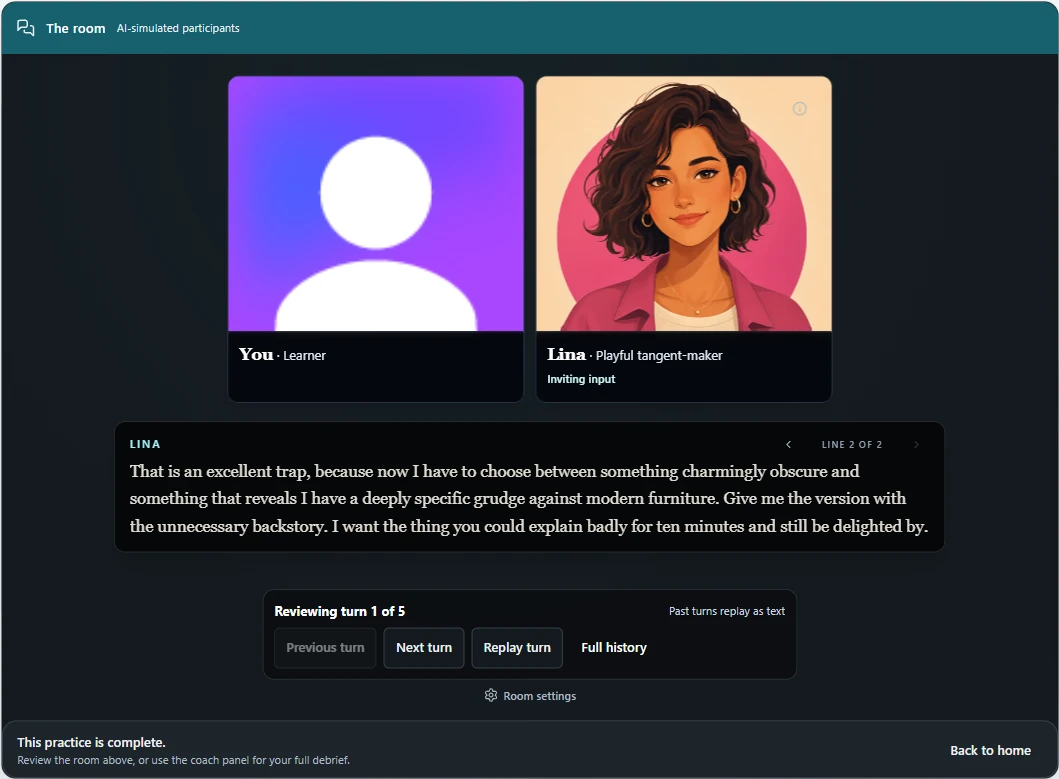
This September 25 demonstration pairs the learner with Lina, a fictional person. She asks what they could talk about for ten minutes. The learner answers:
Honestly? Old maps. The ones where the cartographer ran out of coastline and drew a sea monster instead.
The learner also admits to wondering what the silence meant, then asks about Lina’s own topic. She introduces a deeply specific grudge against modern furniture.
What the Coach adds
The Coach recognizes that the learner gave the conversation something specific to build on while making room for Lina’s perspective. Its next move is:
You could share your topic with one concrete detail before adding the backstory.
On the next turn, the learner offers a detail from a map, then asks for Lina’s furniture story. The conversation follows that shared tangent. Later, Lina says she has about ten minutes before she needs to leave, giving the learner another real constraint to respond to inside the simulation.
The practice is in following what the other person actually gives you: a question, a detail, a time limit. You choose which thread to pick up.
Curiosity needs an answer, too
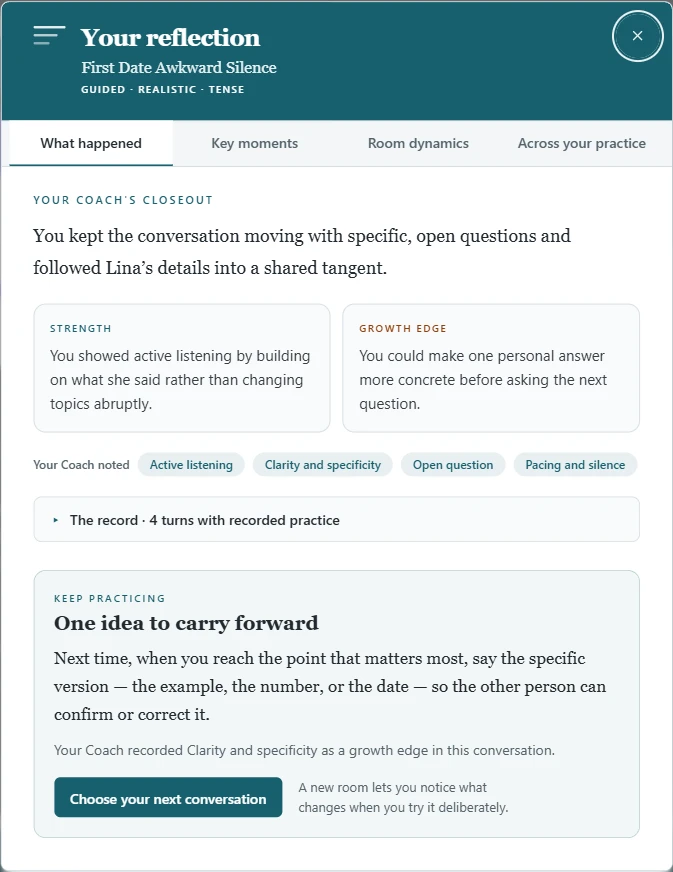
The debrief notices that the learner built on Lina’s details. It also suggests:
You could make one personal answer more concrete before asking the next question.
That gives a second practice a clear focus: offer something of your own that the other person can respond to. The Coach helps with the turn, the debrief reflects on the completed conversation, and Insights brings together patterns across practices.
Take a turn yourself
ForeverLearning AI builds applications around participation and growing capability. In this room, you practice noticing an opening, answering with something specific, and following the reply. The people are fictional; the decisions are yours to make.
Practice this conversation
Your exchange will develop from what you choose to say.
Explore another setting in the series: asking for a raise when the answer changes shape.