
You have taken on more responsibility. Your review went well. Your pay stayed where it was. You prepare the case, ask for a raise, and your manager answers with a different proposal: an increase in stages. Now you have another decision to make.
Conversations gives you a place to practice that decision. You enter a situation, speak in your own words, and respond to AI-simulated people with their own roles and perspectives. The Coach helps you notice what happened and consider your next move. Afterward, a debrief gives you a strength and a growth edge to work with.
Try Salary Negotiation
Try the first few turns with a free account. No credit card required.
Inside the room
This example comes from a demonstration practice recorded on September 24. Dana, the manager, and Riley, an analyst, are fictional. The circumstances and salary figures belong to the simulation. The screenshots show that completed practice in the product.
The learner starts with a fifteen percent request, then gives a concrete example: taking over the client reporting cycle and getting each monthly report out on time. Dana asks for documentation and introduces a staged increase.
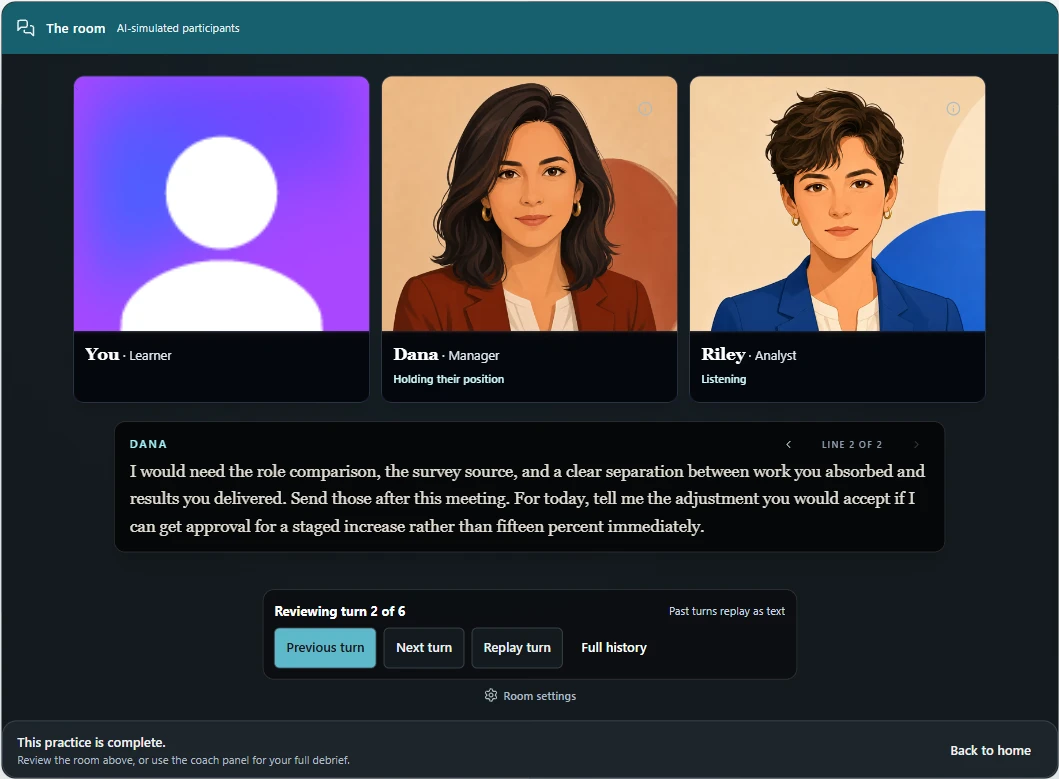
Dana’s response includes:
For today, tell me the adjustment you would accept if I can get approval for a staged increase rather than fifteen percent immediately.
This is the moment the practice becomes useful. The learner has to decide what would make the new proposal meaningful: an amount, a date, and an approval path.
What the Coach noticed
The Coach’s recorded next move after this turn was:
You could ask what amount, timing, and approval condition would make the staged option meaningful.
The learner then proposes an eight percent first step and asks who approves it. Dana identifies Finance and asks for the supporting documents. Over the next two turns, the conversation reaches written criteria for a January review and a deadline for taking the first request to Finance.
That is a practice outcome: a clearer request and a documented next step. The simulated exchange does not establish that a real employer will approve a raise. What you can carry into your own preparation is the question it revealed: what exactly needs to happen next, and who can make that decision?
The debrief gives you something to change
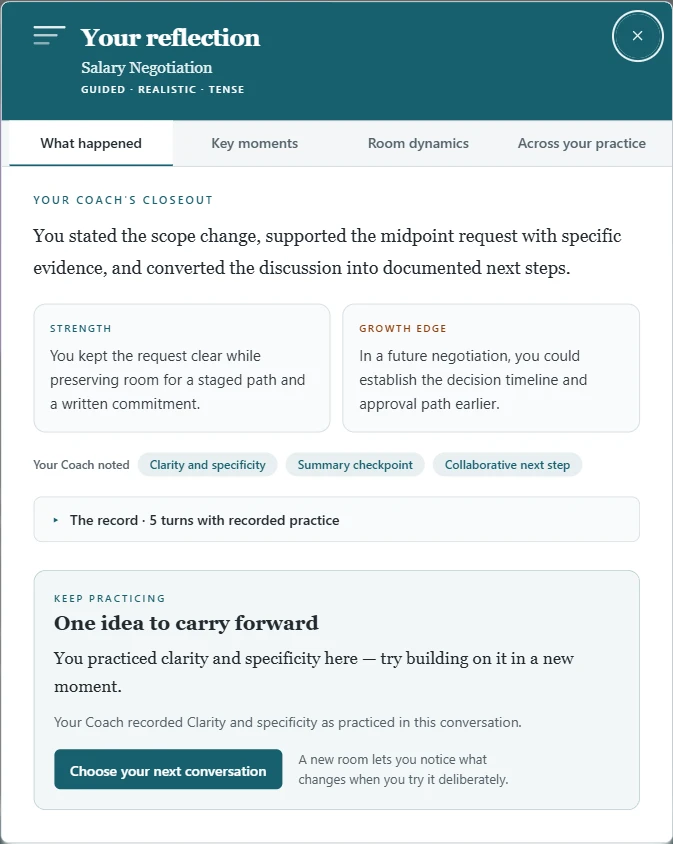
The debrief recognizes that the learner kept the request clear while allowing a staged path. It also names a specific growth edge:
In a future negotiation, you could establish the decision timeline and approval path earlier.
Those questions arrived in turn three. Another practice gives the learner a chance to bring them into the opening. Across completed practices, Insights adds a broader view of recurring techniques, super powers, and growth edges.
Practice the decision yourself
ForeverLearning AI builds applications that help people become more capable. In Conversations, that means making the choices yourself, seeing how others respond, and receiving feedback you can connect to your own words. The useful result is something you can try in your next conversation.
In this room, try making one concrete request and finding out what the other person needs to decide. Your exchange will develop from what you say.
Practice this conversation
Start with a free account and try the first few turns.
Continue the series with announcing a change your team can still influence.